
AI-first search is changing how brands need to think about marketing budgets. Here’s how to rethink your investment across SEO, GEO, content, paid media and Digital PR.

How To Build A Marketing Budget For An AI-First Search Landscape
read more
Two decisions have been quietly dividing performance measurement strategies over the last few weeks.
The first is whether to move to server-side tagging or accept Google’s Tag Gateway as a lighter alternative. The second is how to track brand visibility inside LLMs when Google and Bing are finally releasing native reports, but on their terms.
Both look technical on the surface, and both are commercial calls that determine what your ad platforms optimise against and how much you can trust the visibility data feeding your board reports.
We sat down with our Director of Data & Performance, Chris, to unpack these different approaches to measurement in the context of the latest AI reporting advancements.
Are You Up To Speed?
For a simple introduction to Google Tag Gateway versus server-side tracking, we’ve written a handy guide for marketers that explains their core differences. Feel free to refresh your memory there first, and come back here when you’re ready. |
Google Tag Gateway is the right choice when you need first-party delivery for GA4 and Google Ads quickly and cheaply, but it stops well short of the control server-side tagging gives you.
Tag Gateway does one job. It reroutes requests that would normally go via googletagmanager.com through a subdomain like metrics.yourdomain.com, so the browser treats them as first-party.
That helps with data quality inside Google’s own platforms and reduces losses from some script-level blocking. If you sit behind Cloudflare or Akamai, setup is close to a couple of clicks and a CNAME update.
That’s the ceiling. There is no transformation layer, no server-side logging, no ability to enrich events with CRM or back-end data, and no route to feed non-Google platforms cleanly.
“Google Tag Gateway is just your existing actions, but in a first-party way. Server-side does all of that but also gives you all the control. You’ll have logs, you’ll be able to see whether it’s faster, you can do transformations, you can add in extra data that you have server-side. It’s feature-rich.”
– Chris Hirlemann, Director of Data & Performance, Sleeping Giant Media
The commercial call is straightforward. If your paid media spend is heavily Google-weighted and you want a fast uplift in match rates, Tag Gateway earns its keep. If you’re running material budget through Meta, TikTok, LinkedIn or programmatic, or you need to stitch offline conversions and lifetime value back into bidding signals, Tag Gateway will leave money on the table. Server-side is where enrichment, deduplication and cross-platform Conversions API work sit.
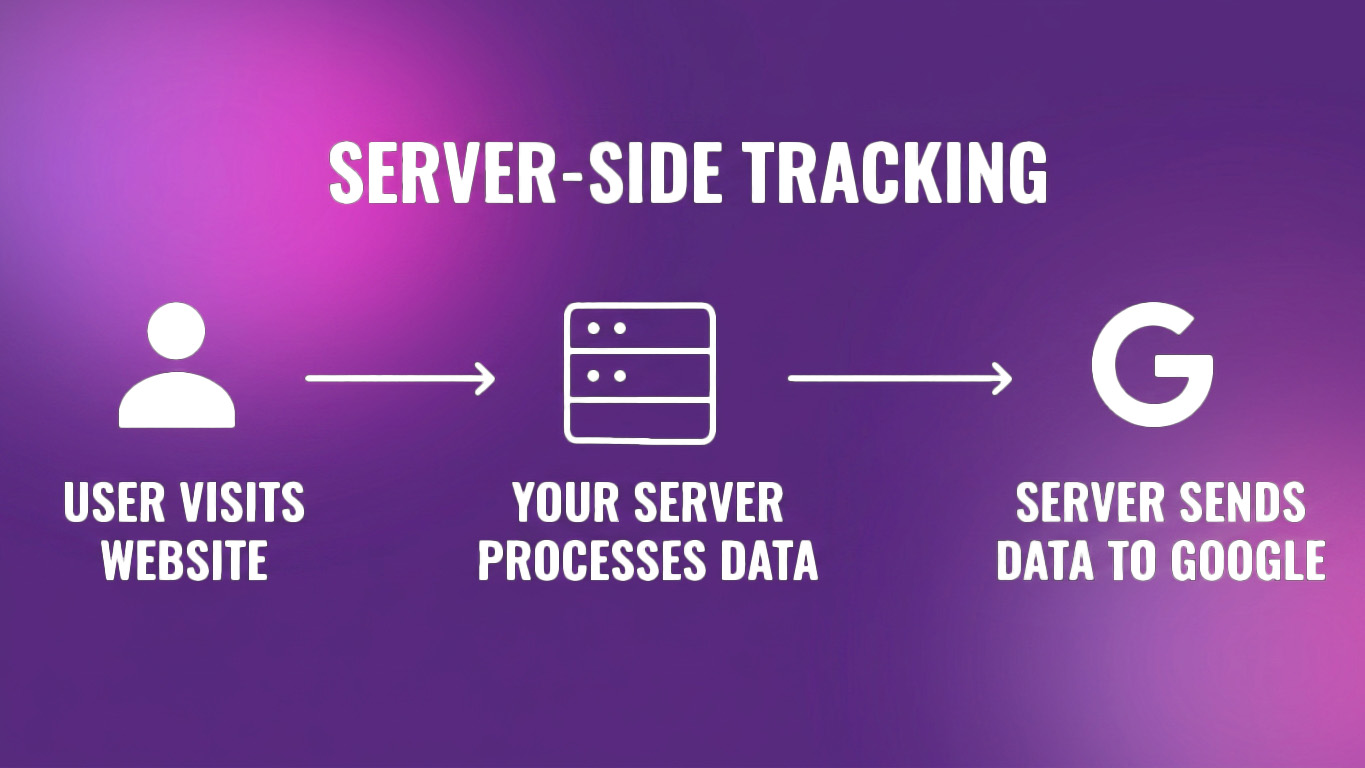
Running server-side as your sole data path removes the redundancy that ad platforms rely on for signal quality, and the small speed gain rarely justifies the risk.
There is a temptation, especially on performance-obsessed ecommerce sites, to route everything server-side and strip the client of tags entirely. Chris is direct on this:
“It isn’t the recommended way of doing things because the platforms actually benefit from having both of those data sources and redundancy in there.”
Dual tagging gives Google and Meta the browser signal and the server signal to reconcile. Remove one, and you weaken attribution modelling in the platforms you’re paying to optimise. Only strip client tags if page speed is a genuine, measured revenue blocker and you’ve exhausted other fixes first. The practical hierarchy for most advertisers looks like this:
| Setup | Best for | Trade-off |
| Client-side only | Very small sites, low budgets | Weakest data quality, most signal loss |
| Google Tag Gateway | Google-heavy spend, limited dev resource | No enrichment, Google ecosystem only |
| Server-side GTM (with client-side retained) | Multi-platform spend, CRM enrichment, offline conversions | Higher setup and maintenance cost |
If you’re not sure where your setup sits, reach out to our Data Team, who can audit it.
Google Tag Gateway is the right choice when you need first-party delivery for GA4 and Google Ads quickly and cheaply, but it stops well short of the control server-side tagging gives you.
Tag Gateway does one job. It reroutes requests that would normally go via googletagmanager.com through a subdomain like metrics.yourdomain.com, so the browser treats them as first-party.
That helps with data quality inside Google’s own platforms and reduces losses from some script-level blocking. If you sit behind Cloudflare or Akamai, setup is close to a couple of clicks and a CNAME update.
That’s the ceiling. There is no transformation layer, no server-side logging, no ability to enrich events with CRM or back-end data, and no route to feed non-Google platforms cleanly.
“Google Tag Gateway is just your existing actions, but in a first-party way. Server-side does all of that but also gives you all the control. You’ll have logs, you’ll be able to see whether it’s faster, you can do transformations, you can add in extra data that you have server-side. It’s feature-rich.”
– Chris Hirlemann, Director of Data & Performance, Sleeping Giant Media
The commercial call is straightforward. If your paid media spend is heavily Google-weighted and you want a fast uplift in match rates, Tag Gateway earns its keep. If you’re running material budget through Meta, TikTok, LinkedIn or programmatic, or you need to stitch offline conversions and lifetime value back into bidding signals, Tag Gateway will leave money on the table. Server-side is where enrichment, deduplication and cross-platform Conversions API work sit.
Running server-side as your sole data path removes the redundancy that ad platforms rely on for signal quality, and the small speed gain rarely justifies the risk.
There is a temptation, especially on performance-obsessed ecommerce sites, to route everything server-side and strip the client of tags entirely. Chris is direct on this:
“It isn’t the recommended way of doing things because the platforms actually benefit from having both of those data sources and redundancy in there.”
Dual tagging gives Google and Meta the browser signal and the server signal to reconcile. Remove one, and you weaken attribution modelling in the platforms you’re paying to optimise. Only strip client tags if page speed is a genuine, measured revenue blocker and you’ve exhausted other fixes first. The practical hierarchy for most advertisers looks like this:
| Setup | Best for | Trade-off |
| Client-side only | Very small sites, low budgets | Weakest data quality, most signal loss |
| Google Tag Gateway | Google-heavy spend, limited dev resource | No enrichment, Google ecosystem only |
| Server-side GTM (with client-side retained) | Multi-platform spend, CRM enrichment, offline conversions | Higher setup and maintenance cost |
If you’re not sure where your setup sits, reach out to our Data Team, who can audit it.
To put it simply: the generative AI reports in Search Console and Bing Webmaster Tools give you the first free view of real LLM impressions, but they deliberately withhold the prompt-level detail that paid tools like Profound still surface.
Google has now launched generative AI performance reports covering AI Overviews and AI Mode, and Bing’s AI Performance report has been live since early 2026, showing citations in Copilot and Bing’s AI answers. Bing’s is more comprehensive, with four new capabilities for breaking activity down: Intents, Topics, Citation Share, and Compare.
Bing will provide you with insight relating to prompts and queries, but it might not be in the format you would expect. Bing will not reveal the exact phrasing that customers use in their queries, but it will show you the grounding queries, key phrases, and interpretive methods utilised by its AI to retrieve content.
Why? Chris explains below.
“It’s now, “where can I find airport parking that fits my SUV with 4 children and a wheelchair?”, and then follow-up questions to that as well. It’s so personalised that there would be a concern of what kind of information you would learn about people.”
This is the same reason “other” swallows so much of your Search Console query data. Personalised, conversational prompts contain identifying details the platforms cannot expose. Expect topic-level reporting to be the ceiling, not a temporary limitation. For marketing leaders, that changes the tooling question.
For most brands, the sequence is: use Search Console and Bing as the source of truth for whether you’re being cited, and reserve paid tools for competitive prompt intelligence on your highest-value themes.
If you’re already using a third-party GEO tool, audit whether it’s telling you something the native reports don’t. If not, redirect that budget into producing the content the topic data says LLMs are surfacing.
The pattern across both decisions is the same. Google and Microsoft are building good-enough native tools that cover 80% of what most marketers need, for free or close to it. The commercial edge now sits in the 20% they won’t give you: server-side enrichment with your own first-party data, and prompt-level intelligence in the categories where you compete hardest. Spend accordingly.
Ultimately, Google Tag Gateway is sufficient if you’ve got limited development resources and rely on Google ecosystems only. If you want to future-proof your tracking and gain full control (and you can accommodate the additional spend), then server-side tracking is a no-brainer. As for GSC and Bing Webmaster’s reports, now’s the time to start testing and getting familiar with the data they can show.
If you’d like a view on where your current setup is leaving value on the table, get in touch with the team and explore our data and tracking services.
And, for more expert insights on the latest developments in paid, SEO, and performance measurement, keep up with our blog and free events for marketing leaders.

The pattern across both decisions is the same. Google and Microsoft are building good-enough native tools that cover 80% of what most marketers need, for free or close to it. The commercial edge now sits in the 20% they won’t give you: server-side enrichment with your own first-party data, and prompt-level intelligence in the categories where you compete hardest. Spend accordingly.
Ultimately, Google Tag Gateway is sufficient if you’ve got limited development resources and rely on Google ecosystems only. If you want to future-proof your tracking and gain full control (and you can accommodate the additional spend), then server-side tracking is a no-brainer. As for GSC and Bing Webmaster’s reports, now’s the time to start testing and getting familiar with the data they can show.
If you’d like a view on where your current setup is leaving value on the table, get in touch with the team and explore our data and tracking services.
And, for more expert insights on the latest developments in paid, SEO, and performance measurement, keep up with our blog and free events for marketing leaders.
Ready for a digital marketing partner that delivers clear scoping, full transparency, and proven results? Fill out the form below to connect directly with the Sleeping Giant Media team and discover how we can help your business thrive.
AI-first search is changing how brands need to think about marketing budgets. Here’s how to rethink your investment across SEO, GEO, content, paid media and Digital PR.

ChatGPT Work and Claude Design 2.0 are changing how marketing teams create, automate and manage work. But as AI takes on more of the workflow, what happens to human oversight, brand ownership and compliance?
Reddit’s share of ChatGPT citations dropped by 86.4% in just four days. So, what happened? We look at what the change could mean for AI visibility, why relying too heavily on a single citation source creates risk, and what marketers should be doing to build a more resilient strategy.