
AI-first search is changing how brands need to think about marketing budgets. Here’s how to rethink your investment across SEO, GEO, content, paid media and Digital PR.
How To Build A Marketing Budget For An AI-First Search Landscape
read more
Supermetrics has quietly shipped something that should reshape how performance teams operate: a Model Context Protocol (MCP) server that lets Claude, and any other MCP-compatible LLM, query live marketing data across 170+ platforms through natural language. Got all that?
For marketing leaders, the interesting question isn’t whether to plug it in. It’s what happens to the analyst function, the dashboard layer, and the governance model once anyone in the business can ask their paid media data a question and get a coherent answer back.
We sat down with Chris from our data and performance team to work through what’s actually changed for Supermetrics, where the risk sits, and what teams should stop investing in.
The short version: the tooling has democratised access, but it has raised the bar on context, not lowered it.
The Supermetrics MCP server removes the integration tax on conversational analytics by giving LLMs a single, governed route into 170+ marketing platforms, rather than forcing teams to stitch together one-off connectors per channel.
Until now, “talk to your data” demos collapsed the moment you needed to query Meta, Google Ads, and GA4 in the same breath. Every platform required its own MCP, its own auth, its own schema quirks. Supermetrics has been the middleware layer for sheets and BI tools for years. Extending that role to LLMs is the obvious move, and it’s the one that makes conversational analytics viable at agency and in-house scale. As Chris put it:
“You can just have a conversation with your data. Because Supermetrics also connects to lots of different data sources, you don’t have to worry about whether there is an MCP for Facebook or any other platform. It’s just the same way of grabbing that data you may have been using for Google Sheets, you can now use for your conversational run with data.”
– Chris Hirlemann, Director of Data & Performance
The commercial implication: if your reporting roadmap still centres on building more Looker Studio dashboards, pause it. A large portion of the ad-hoc questions that a dashboard exists to answer can now be handled conversationally, and the build cost is closer to zero. Reserve dashboarding for the metrics that genuinely need a persistent, governed view.
Conversational access to marketing data only works when an LLM is fed the context an experienced analyst would normally apply silently – and most organisations have never documented that context.
The seductive pitch is that anyone can now ‘self-serve.’ The reality is that any non-trivial GA4 or paid media setup carries dozens of undocumented quirks: custom dimensions that need filtering, conversion events that double-count, channel groupings that don’t match the CRM, and attribution windows that vary by platform. An LLM will answer confidently without knowing any of that.
Now, that’s not a Claude problem. It’s a context problem, and it scales with the complexity of your tracking. The fix is unglamorous: structured knowledge files describing the nuances of your setup, maintained by someone who actually understands the data model. If you don’t already have a written record of how your analytics environment deviates from default behaviour, that document is now a prerequisite for safe LLM access, not a nice-to-have.
The Supermetrics MCP server removes the integration tax on conversational analytics by giving LLMs a single, governed route into 170+ marketing platforms, rather than forcing teams to stitch together one-off connectors per channel.
Until now, “talk to your data” demos collapsed the moment you needed to query Meta, Google Ads, and GA4 in the same breath. Every platform required its own MCP, its own auth, its own schema quirks. Supermetrics has been the middleware layer for sheets and BI tools for years. Extending that role to LLMs is the obvious move, and it’s the one that makes conversational analytics viable at agency and in-house scale. As Chris put it:
“You can just have a conversation with your data. Because Supermetrics also connects to lots of different data sources, you don’t have to worry about whether there is an MCP for Facebook or any other platform. It’s just the same way of grabbing that data you may have been using for Google Sheets, you can now use for your conversational run with data.”
– Chris Hirlemann, Director of Data & Performance
The commercial implication: if your reporting roadmap still centres on building more Looker Studio dashboards, pause it. A large portion of the ad-hoc questions that a dashboard exists to answer can now be handled conversationally, and the build cost is closer to zero. Reserve dashboarding for the metrics that genuinely need a persistent, governed view.
Conversational access to marketing data only works when an LLM is fed the context an experienced analyst would normally apply silently – and most organisations have never documented that context.
The seductive pitch is that anyone can now ‘self-serve.’ The reality is that any non-trivial GA4 or paid media setup carries dozens of undocumented quirks: custom dimensions that need filtering, conversion events that double-count, channel groupings that don’t match the CRM, and attribution windows that vary by platform. An LLM will answer confidently without knowing any of that.
Now, that’s not a Claude problem. It’s a context problem, and it scales with the complexity of your tracking. The fix is unglamorous: structured knowledge files describing the nuances of your setup, maintained by someone who actually understands the data model. If you don’t already have a written record of how your analytics environment deviates from default behaviour, that document is now a prerequisite for safe LLM access, not a nice-to-have.
The high-value analyst skill has shifted from data wrangling to question design and output validation, which means hiring criteria and training plans built around SQL, R, or Python fluency are increasingly mis-calibrated.
Chris was direct on this:
“There was a time when learning R was on my list. But now you don’t really need to learn this in detail. You can get Claude Code or ChatGPT to put it together. You need to know what the right questions are.”
If you lead a performance or insight team, the practical implications are:
Make critical review a formal step, not an afterthought. Every conversational query that informs a decision over a defined spend threshold should be cross-checked against curated reference data.
Curated, top-line reporting becomes more valuable, not less, once conversational querying is in play, because it’s the only reliable way to spot when an LLM has hallucinated a plausible-looking answer.
| This is the point that most “AI will replace dashboards” takes miss. If you know your weekly revenue is £400,000 across 500 transactions, and Claude tells you a single campaign drove half of that, you’ll catch it instantly. Without that anchor, you won’t. The most dangerous outputs are the ones that are 80% correct, because the wrong 20% slips through unchallenged. |
A workable rule of thumb from the conversation: scale your validation to the size of the decision. A two-hour tactical call can run on a quick conversational query. A £2.5m website investment cannot.

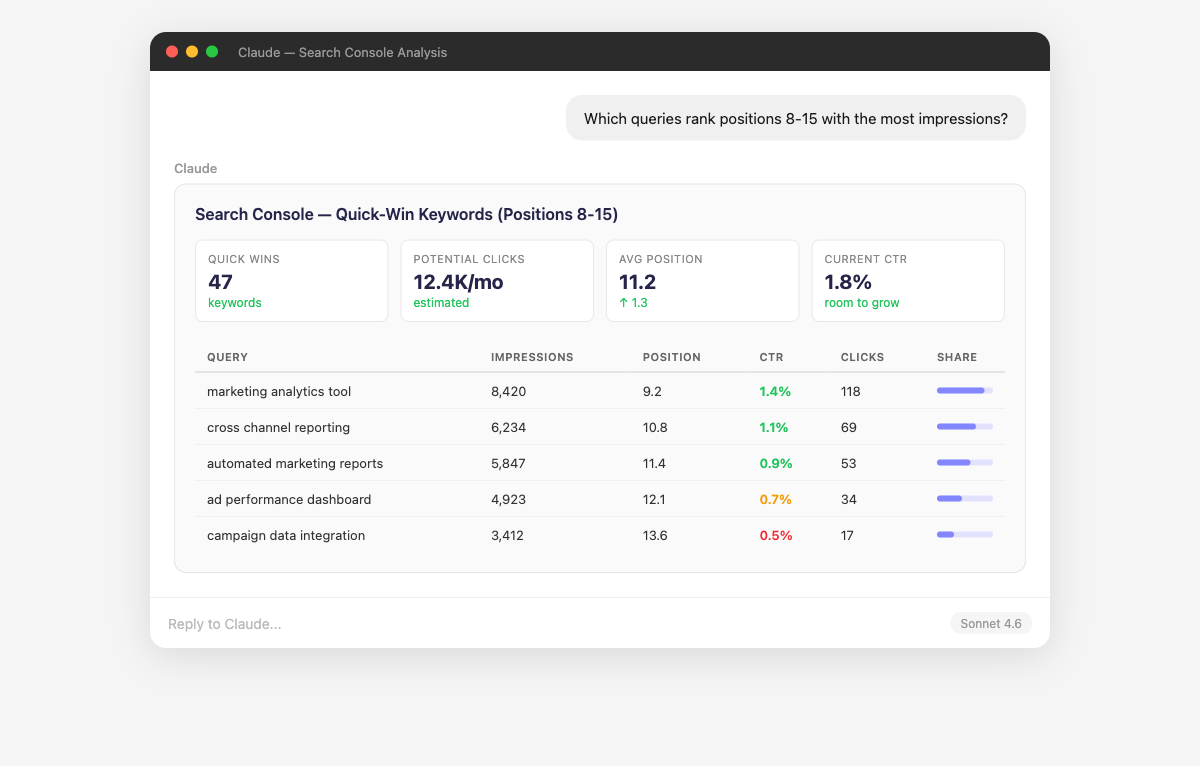
Conversational analytics performs best on narrow, single-source questions, and degrades sharply as queries become multi-step, cross-platform or dependent on bespoke business logic.
“How many mobile sessions last week?” is safe. “What’s the incremental ROAS contribution of our LinkedIn programme adjusted for view-through?” is not – at least not without heavy context engineering. The teams getting value from MCP integrations today are the ones using them to compress the time spent on simple lookups, not the ones trying to replace analyst-led measurement work.
Curated, top-line reporting becomes more valuable, not less, once conversational querying is in play, because it’s the only reliable way to spot when an LLM has hallucinated a plausible-looking answer.
| This is the point that most “AI will replace dashboards” takes miss. If you know your weekly revenue is £400,000 across 500 transactions, and Claude tells you a single campaign drove half of that, you’ll catch it instantly. Without that anchor, you won’t. The most dangerous outputs are the ones that are 80% correct, because the wrong 20% slips through unchallenged. |
A workable rule of thumb from the conversation: scale your validation to the size of the decision. A two-hour tactical call can run on a quick conversational query. A £2.5m website investment cannot.
Conversational analytics performs best on narrow, single-source questions, and degrades sharply as queries become multi-step, cross-platform or dependent on bespoke business logic.
“How many mobile sessions last week?” is safe. “What’s the incremental ROAS contribution of our LinkedIn programme adjusted for view-through?” is not – at least not without heavy context engineering. The teams getting value from MCP integrations today are the ones using them to compress the time spent on simple lookups, not the ones trying to replace analyst-led measurement work.
If you’d like a view on how to structure your data, knowledge files, and reporting layer to get value from MCP-based tooling, without inheriting the risk, get in touch with the team.
For more of the latest AI and marketing insights, keep up to date with our blog and busy calendar of events for marketing leaders.
Ready for a digital marketing partner that delivers clear scoping, full transparency, and proven results? Fill out the form below to connect directly with the Sleeping Giant Media team and discover how we can help your business thrive.
AI-first search is changing how brands need to think about marketing budgets. Here’s how to rethink your investment across SEO, GEO, content, paid media and Digital PR.
ChatGPT Work and Claude Design 2.0 are changing how marketing teams create, automate and manage work. But as AI takes on more of the workflow, what happens to human oversight, brand ownership and compliance?
Reddit’s share of ChatGPT citations dropped by 86.4% in just four days. So, what happened? We look at what the change could mean for AI visibility, why relying too heavily on a single citation source creates risk, and what marketers should be doing to build a more resilient strategy.