AI-first search is changing how brands need to think about marketing budgets. Here’s how to rethink your investment across SEO, GEO, content, paid media and Digital PR.
How To Build A Marketing Budget For An AI-First Search Landscape
read more
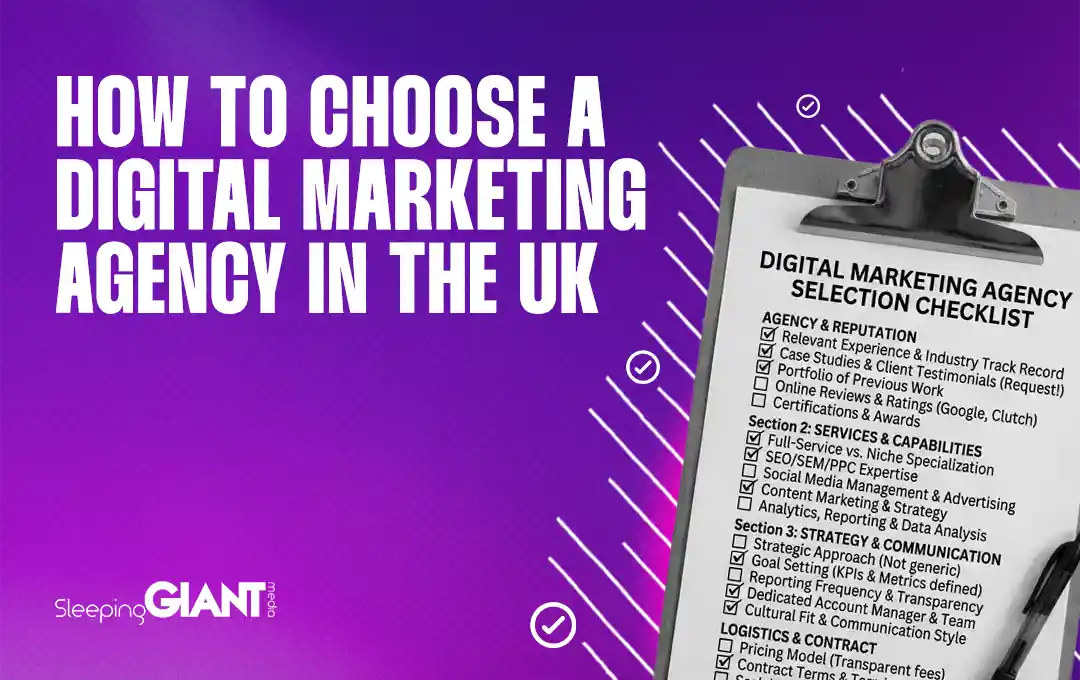
Selecting a digital marketing agency in 2026 requires confidence in how the organisation navigates modern search, where objectives and best practices are continually changing.
In its Q4 2025 earnings, Alphabet reported that Google Search saw more usage than ever, and that AI is driving what it called an “expansionary moment”, with daily AI Mode queries continuing to grow at an accelerated rate.
The agency you choose must compete not only for search rankings but also for citations within AI-generated answers that your potential customers see first.
With this in mind, choosing a digital marketing agency in the UK this year doesn’t just mean picking one that has a solid reputation and portfolio in traditional SEO: it must also have a strategy and an openness to adapt to the demands of AI search and GEO.
This guide outlines how to define your requirements and the questions to ask that distinguish agencies prepared for AI search from those relying on outdated practices.


Define your success criteria before briefing or engaging agencies. Agencies can only scope, price, and be evaluated against clear commercial targets you establish, not assumptions they create.
Most unsuccessful partnerships result from briefs that lack defined success metrics, leading to unfocused objectives and irrelevant reporting.
Before contacting agencies, you need to determine your desired outcomes, such as an increased pipeline, more leads, an increase in organic revenue, social media growth and conversions, AI citations, or stronger SEO performance against competitors.
Selecting a digital marketing agency in 2026 requires confidence in how the organisation navigates modern search, where objectives and best practices are continually changing.
In its Q4 2025 earnings, Alphabet reported that Google Search saw more usage than ever, and that AI is driving what it called an “expansionary moment”, with daily AI Mode queries continuing to grow at an accelerated rate.
The agency you choose must compete not only for search rankings but also for citations within AI-generated answers that your potential customers see first.
With this in mind, choosing a digital marketing agency in the UK this year doesn’t just mean picking one that has a solid reputation and portfolio in traditional SEO: it must also have a strategy and an openness to adapt to the demands of AI search and GEO.
This guide outlines how to define your requirements and the questions to ask that distinguish agencies prepared for AI search from those relying on outdated practices.
Define your success criteria before briefing or engaging agencies. Agencies can only scope, price, and be evaluated against clear commercial targets you establish, not assumptions they create.
Most unsuccessful partnerships result from briefs that lack defined success metrics, leading to unfocused objectives and irrelevant reporting.
Before contacting agencies, you need to determine your desired outcomes, such as an increased pipeline, more leads, an increase in organic revenue, social media growth and conversions, AI citations, or stronger SEO performance against competitors.
Proposals with similar day rates may offer very different value and ROI. Evaluate each by examining deliverables, team seniority, and reporting before making a decision based solely on price.
A retainer that secures a senior strategist for three days a week differs significantly from the same fee spent on a junior executive and software that may not add value or integrate with your workflows.
Ask every agency to itemise who does the work, how many hours land against your account, and what you own at the end. Once you line the proposals up in one grid, the cheap option has a habit of turning out to be the expensive one and the one that will provide the least ROI over the long term.
Ask agencies how they secure citations in AI Overviews and chat responses, and how they track this visibility. Agencies unable to answer directly may be optimising for content with limited reach.
The phrase ‘AI SEO agency’ sits on almost every homepage now, so the value is in pressing past the label. A supplier that has adapted will talk about structured, meaningful content, entity coverage, and getting clients cited. One that has not will steer you back towards keyword rankings alone and hope you do not notice the goalposts have moved.
Anyone can publish “AI SEO agency” on a homepage, so look for proof.


Avoid agencies that guarantee rankings, do not identify account leads, refuse to provide a point of contact, or cannot explain their reporting clearly. These are signs of a supplier focused on managing expectations rather than delivering results.
Be alert for early warning signs in initial meetings. Guarantees of first-place rankings are unrealistic, as no agency controls Google’s algorithm or the outcomes of AI-generated answers.
A trustworthy supplier is transparent about what they can, and cannot, guarantee.
“One of the big challenges is you cannot measure anything year on year, pretty much, anymore because clicks are disappearing because actually people don’t go to websites as much anymore…they’re doing a lot of their research through the top middle part of the funnel all on AI engines, whether that’s ChatGPT, or whether that’s in AI mode or using AI overviews.”
– Luke Quilter, CEO, Sleeping Giant Media
Ask agencies how they secure citations in AI Overviews and chat responses, and how they track this visibility. Agencies unable to answer directly may be optimising for content with limited reach.
The phrase ‘AI SEO agency’ sits on almost every homepage now, so the value is in pressing past the label. A supplier that has adapted will talk about structured, meaningful content, entity coverage, and getting clients cited. One that has not will steer you back towards keyword rankings alone and hope you do not notice the goalposts have moved.
Anyone can publish “AI SEO agency” on a homepage, so look for proof.
Avoid agencies that guarantee rankings, do not identify account leads, refuse to provide a point of contact, or cannot explain their reporting clearly. These are signs of a supplier focused on managing expectations rather than delivering results.
Be alert for early warning signs in initial meetings. Guarantees of first-place rankings are unrealistic, as no agency controls Google’s algorithm or the outcomes of AI-generated answers.
A trustworthy supplier is transparent about what they can, and cannot, guarantee.
“One of the big challenges is you cannot measure anything year on year, pretty much, anymore because clicks are disappearing because actually people don’t go to websites as much anymore…they’re doing a lot of their research through the top middle part of the funnel all on AI engines, whether that’s ChatGPT, or whether that’s in AI mode or using AI overviews.”
– Luke Quilter, CEO, Sleeping Giant Media
Selecting a digital marketing agency in the UK depends on a clear brief with defined objectives and targeted questions that reveal whether a supplier is prepared for AI search or relies on outdated SEO practices.
If you are seeking a digital marketing agency that provides clear answers and has proven expertise in establishing clients as trusted, AI-cited authorities, contact the team at Sleeping Giant Media.
Ready for a digital marketing partner that delivers clear scoping, full transparency, and proven results? Fill out the form below to connect directly with the Sleeping Giant Media team and discover how we can help your business thrive.
AI-first search is changing how brands need to think about marketing budgets. Here’s how to rethink your investment across SEO, GEO, content, paid media and Digital PR.
ChatGPT Work and Claude Design 2.0 are changing how marketing teams create, automate and manage work. But as AI takes on more of the workflow, what happens to human oversight, brand ownership and compliance?
Reddit’s share of ChatGPT citations dropped by 86.4% in just four days. So, what happened? We look at what the change could mean for AI visibility, why relying too heavily on a single citation source creates risk, and what marketers should be doing to build a more resilient strategy.