AI-first search is changing how brands need to think about marketing budgets. Here’s how to rethink your investment across SEO, GEO, content, paid media and Digital PR.

How To Build A Marketing Budget For An AI-First Search Landscape
read more
Ask ChatGPT or Google Gemini to recommend a company in your industry and see what happens. They might name two or three brands, a fourth, and then ask whether you want to tighten your query with product and service recommendations, or ask another question entirely.
This blind spot is what AI visibility tools aim to help your organisation address. You can hold the number one spot on Google and still go unmentioned when someone asks a large language model (LLM) the same question. Why? Partly because the smallest changes in language or user intent can completely alter how an AI chatbot responds.
These factors have proved to be a catalyst for a now-crowded market of tools that has appeared almost overnight, priced anywhere from a few pounds a month to five figures. And working out the best choices for your business in this new search arena can be a challenging prospect.
Our guide examines some of the best AI visibility tools worth paying for in 2026 and the factors you need to consider before making a purchase.
“AI visibility tools work in much the same way as traditional keyword tracking, but they give you a much richer picture of how your brand is appearing across AI search. They can show whether you’re being mentioned, how you’re being represented, which competitors are appearing and where you’re being cited.”
Chris Hirlemann, Director of Data & Performance, Sleeping Giant Media.
AI visibility tools run the questions your buyers actually ask across major AI platforms, such as ChatGPT, Perplexity, Gemini, Google AI Overviews and AI Mode, and Microsoft Copilot.
They then report whether you were named, how often, in what capacity, and if competitors were cited before you or instead of you.
AI answers are now a major force in research and product-discovery user queries. While you’d be forgiven for thinking that all AI engines process data and make recommendations in the same way, they don’t.
So, while you can build an AI search strategy to appeal to all of them, there’s no guarantee that your brand will achieve success with all of them, and in the same way.
The AI visibility tools we recommend measure your position and can provide insight into how you can improve citation rates, but visibility still has to be earned with Generative Engine Optimisation (GEO), strong SEO foundations, impactful digital PR, and quality content.
Want your brand cited? Talk to us
You measure AI visibility with signals that classic SEO never had to track before:
There are two distinct ways in which your brand may turn up in an AI answer: a mention (in which you are mentioned in AI generation response) or a citation, which is more valuable as it also links to a page or resource you own.
AI visibility tools could track how often you appear as a cited brand across all engines, for example. Or they may indicate whether you are considered a trustworthy source the LLM can link to and cite.
As an emerging field, there are no hard-and-fast rules for measuring AI visibility (though our handy guide offers some pointers for marketers). Still, the tools below are the current market’s best options when it comes to gaining some insight into your brand’s performance in AI search.

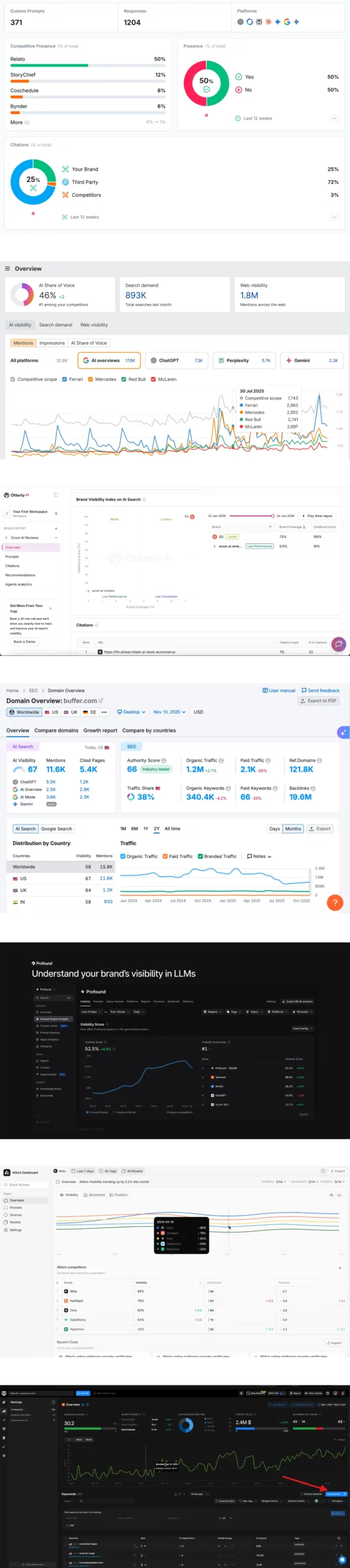
Scrunch earns its place by answering the question dashboards may avoid: do AI citations lead to conversions and revenue? Claiming a 364% increase in brand presence for non-branded prompts in a case study, Scrunch provides tools for enterprises and agencies to track citations, address visibility gaps, and track emerging trends. Prices begin at $250/month (approximately £184/month).*
For anyone already paying for Ahrefs, Brand Radar tracks mentions and citations across five engines, including Perplexity, ChatGPT, and Claude. Its prompts are pulled from real search behaviour instead of invented questions.
This £99+ option is solid as its recommendations are based on what people actually type into a search box, and the Ahrefs database includes 463 million prompts and counting.
Otterly is the easiest way to answer the question “are we even showing up?” without a budget meeting. It starts at $29 (around £21/month), covers the core engines, and includes a GEO audit that provides specific fixes, so you are not left staring at a score.
The main compromise is a weekly data refresh, so you are always looking at last week’s picture, which is fine for a baseline and less so once you are optimising actively.
If your team already uses Semrush, the AI Toolkit lets you track visibility without switching platforms. For $99 per month (around £73/month) per domain, you get a large prompt database, daily data updates, and a workflow that covers everything from finding gaps to fixing them.
Its AI features may not be as advanced as those in specialised tools, but having everything in one place is a big advantage.
Unpack your AI visibility today
Profound is built for enterprises and offers source-level citation tracking, real-time monitoring on at least ten engines, and SOC 2 compliance.
The Starter plan costs about $99 per month (£73/month) but only covers ChatGPT. Adding more engines raises the price to enterprise levels, which you can get by request. Profound works best for large brands with advanced GEO programs.
Peec is a great choice if you want some of the best value for money. It has grown quickly outside Europe by providing mid-market teams with most of the analytics that are actually used across multiple AI engines, and it starts at about EUR 89 per month (approximately £76/month).
Visibility, position, and sentiment are all there. For most brands that want proper multi-engine tracking without an enterprise contract, this is the sensible solution.
Nightwatch takes a dual-layer approach, folding AI answer tracking in alongside conventional SEO rank tracking so both live on one screen. This will appeal to teams who do not want to run their GEO reporting somewhere separate from their Google rankings. Pricing begins at EUR 79 (roughly £67) per month.
“Third-party tools do have their place and can provide great insight. But it’s always worth validating what you find in Search Console first. Otherwise, you can end up optimising for a tool rather than optimising for what you’re actually seeing and experiencing in search.”
Nik Riccardi, SEO Manger, Sleeping Giant Media
AI visibility tools run the questions your buyers actually ask across major AI platforms, such as ChatGPT, Perplexity, Gemini, Google AI Overviews and AI Mode, and Microsoft Copilot.
They then report whether you were named, how often, in what capacity, and if competitors were cited before you or instead of you.
AI answers are now a major force in research and product-discovery user queries. While you’d be forgiven for thinking that all AI engines process data and make recommendations in the same way, they don’t.
So, while you can build an AI search strategy to appeal to all of them, there’s no guarantee that your brand will achieve success with all of them, and in the same way.
The AI visibility tools we recommend measure your position and can provide insight into how you can improve citation rates, but visibility still has to be earned with Generative Engine Optimisation (GEO), strong SEO foundations, impactful digital PR, and quality content.
Want your brand cited? Talk to us
You measure AI visibility with signals that classic SEO never had to track before:
There are two distinct ways in which your brand may turn up in an AI answer: a mention (in which you are mentioned in AI generation response) or a citation, which is more valuable as it also links to a page or resource you own.
AI visibility tools could track how often you appear as a cited brand across all engines, for example. Or they may indicate whether you are considered a trustworthy source the LLM can link to and cite.
As an emerging field, there are no hard-and-fast rules for measuring AI visibility (though our handy guide offers some pointers for marketers). Still, the tools below are the current market’s best options when it comes to gaining some insight into your brand’s performance in AI search.
Scrunch earns its place by answering the question dashboards may avoid: do AI citations lead to conversions and revenue? Claiming a 364% increase in brand presence for non-branded prompts in a case study, Scrunch provides tools for enterprises and agencies to track citations, address visibility gaps, and track emerging trends. Prices begin at $250/month (approximately £184/month).*
For anyone already paying for Ahrefs, Brand Radar tracks mentions and citations across five engines, including Perplexity, ChatGPT, and Claude. Its prompts are pulled from real search behaviour instead of invented questions.
This £99+ option is solid as its recommendations are based on what people actually type into a search box, and the Ahrefs database includes 463 million prompts and counting.
Otterly is the easiest way to answer the question “are we even showing up?” without a budget meeting. It starts at $29 (around £21/month), covers the core engines, and includes a GEO audit that provides specific fixes, so you are not left staring at a score.
The main compromise is a weekly data refresh, so you are always looking at last week’s picture, which is fine for a baseline and less so once you are optimising actively.
If your team already uses Semrush, the AI Toolkit lets you track visibility without switching platforms. For $99 per month (around £73/month) per domain, you get a large prompt database, daily data updates, and a workflow that covers everything from finding gaps to fixing them.
Its AI features may not be as advanced as those in specialised tools, but having everything in one place is a big advantage.
Unpack your AI visibility today
Profound is built for enterprises and offers source-level citation tracking, real-time monitoring on at least ten engines, and SOC 2 compliance.
The Starter plan costs about $99 per month (£73/month) but only covers ChatGPT. Adding more engines raises the price to enterprise levels, which you can get by request. Profound works best for large brands with advanced GEO programs.
Peec is a great choice if you want some of the best value for money. It has grown quickly outside Europe by providing mid-market teams with most of the analytics that are actually used across multiple AI engines, and it starts at about EUR 89 per month (approximately £76/month).
Visibility, position, and sentiment are all there. For most brands that want proper multi-engine tracking without an enterprise contract, this is the sensible solution.
Nightwatch takes a dual-layer approach, folding AI answer tracking in alongside conventional SEO rank tracking so both live on one screen. This will appeal to teams who do not want to run their GEO reporting somewhere separate from their Google rankings. Pricing begins at EUR 79 (roughly £67) per month.
“Third-party tools do have their place and can provide great insight. But it’s always worth validating what you find in Search Console first. Otherwise, you can end up optimising for a tool rather than optimising for what you’re actually seeing and experiencing in search.”
Nik Riccardi, SEO Manger, Sleeping Giant Media
A digital PR agency uses AI visibility tools to see which questions you’re winning and losing at, where your competitors stand, and which third-party sources the engines trust.
Armed with this strategic insight, they then earn the coverage and produce the content that changes those answers.
If you want to know whether AI is recommending you or your competitors, and to build the earned coverage that changes the answer, get in touch with the team at Sleeping Giant Media today.
For the latest AI updates and strategic business use case insights, keep up with our blog and free events for marketing leaders.
Ready for a digital marketing partner that delivers clear scoping, full transparency, and proven results? Fill out the form below to connect directly with the Sleeping Giant Media team and discover how we can help your business thrive.
AI-first search is changing how brands need to think about marketing budgets. Here’s how to rethink your investment across SEO, GEO, content, paid media and Digital PR.
ChatGPT Work and Claude Design 2.0 are changing how marketing teams create, automate and manage work. But as AI takes on more of the workflow, what happens to human oversight, brand ownership and compliance?
Reddit’s share of ChatGPT citations dropped by 86.4% in just four days. So, what happened? We look at what the change could mean for AI visibility, why relying too heavily on a single citation source creates risk, and what marketers should be doing to build a more resilient strategy.