AI-first search is changing how brands need to think about marketing budgets. Here’s how to rethink your investment across SEO, GEO, content, paid media and Digital PR.
How To Build A Marketing Budget For An AI-First Search Landscape
read more
OpenAI’s ad pilot has expanded to the UK, making Britain the first European market in its global rollout, with Zalando announced as the launch partner.
While it may be tempting to view this as another beta, ChatGPT Ads work differently from established platforms like Google and Meta. The commercial model, consent framework, and advertiser access are all evolving, meaning early decisions could shape how brands establish a presence in conversational search.
For now, there is one important limitation. Although UK users can see ads, the self-serve Ads Manager remains available only in the US. OpenAI has not confirmed when UK advertisers will gain access.
In this guide, we explore what the pilot means for UK brands and what marketers should be doing now, with insights from our Associate Senior Paid Lead, Yumna Kumran.
ChatGPT Ads: Key facts |
||
| ChatGPT ads officially launched in the UK in June 2026. | Anyone can sign up to advertise in ChatGPT immediately with zero minimum spend. | ChatGPT has over 900 million global active users per week. |
| Currently, ads only show to free users; premium subscription tiers (Plus, Pro, and Enterprise) stay completely ad-free. | Bidding uses conversational context and “hints” instead of traditional keywords. | OpenAI’s recommended Cost-Per-Click (CPC) range for self-serve ChatGPT campaigns is $3.00 to $5.00. |
If you’re already acquainted with AI ads (maybe you’ve read our Google vs GPT ads blog?), then feel free to skip ahead.
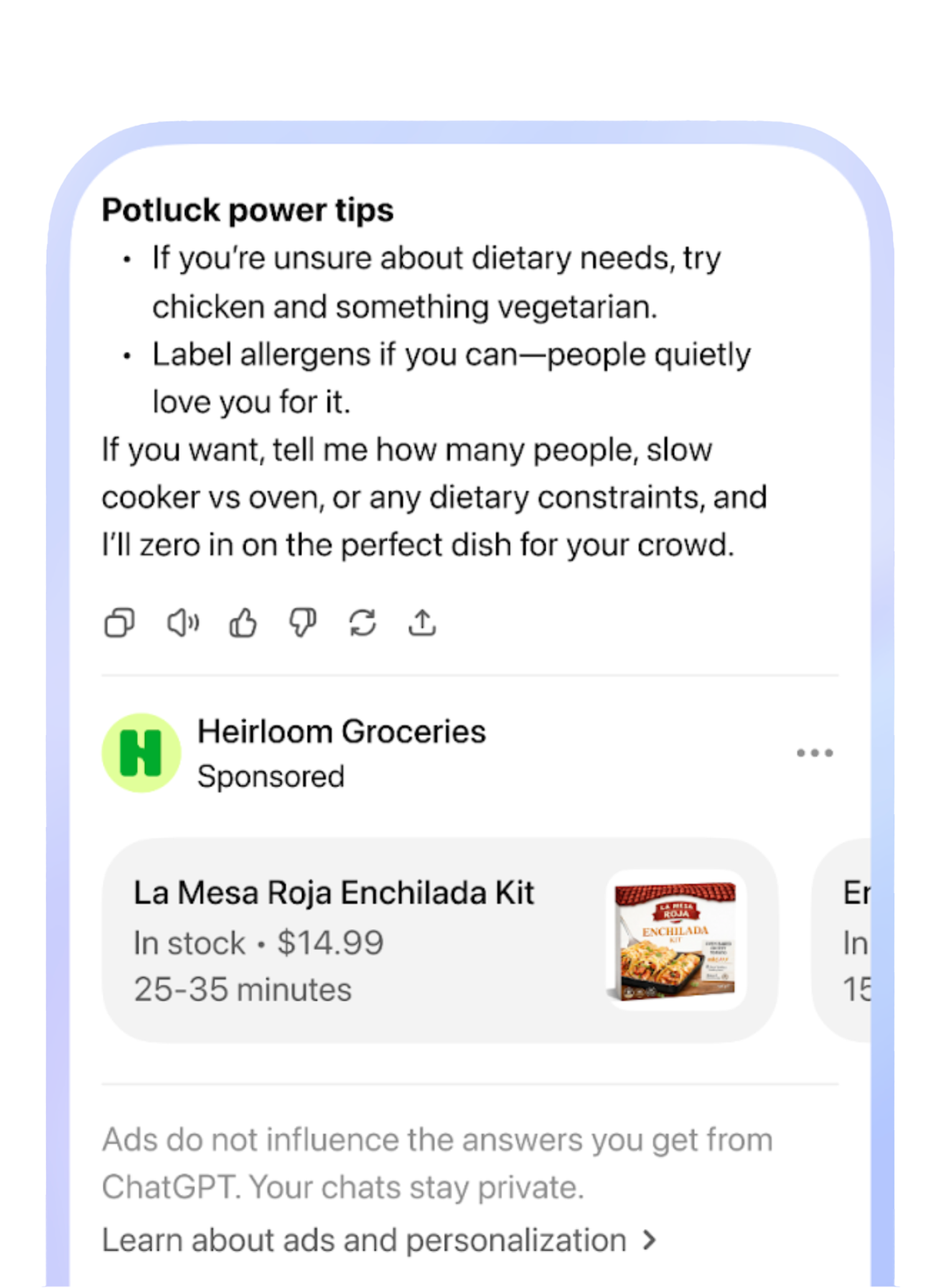
To understand this new channel, it is helpful to look at how conversational ad units function compared to traditional media:
“ChatGPT ads are a massive shift for paid teams. Because they’re built around conversations and intent rather than just keywords, they show a ton of promise. But naturally, there’s a lot of anxiety right now about how they’re going to impact performance across our other paid platforms.”
– Yumna Kumran, Associate Senior Paid Lead.
Advertising on ChatGPT allows you to get your brand in front of people at crucial decision-making stages, often searching with intent to purchase or convert. And, unlike people scrolling through social feeds, AI users aren’t being interrupted; they’re researching.
| Pros of GPT ads | Cons of GPT ads |
| Ads appear when users are actively researching, comparing products, or looking for recommendations, rather than passively scrolling. | Ads currently only appear to eligible users on Free and Go plans in supported markets, limiting overall reach compared with Google or Meta. |
| Sponsored placements are designed to fit naturally into conversations and are clearly labelled, helping maintain a positive user experience. | The platform is new, with relatively little long-term performance data or established benchmarks compared with mature ad platforms. |
| Advertisers receive aggregated performance data only, while conversations remain private and ad content cannot influence ChatGPT’s answers. | Targeting, measurement, and best practices are still evolving, meaning campaigns may require more testing than established channels. |
| Brands can experiment before the platform becomes more competitive as advertiser adoption grows. | The current format is focused on sponsored conversational placements, offering less creative flexibility than social or display advertising. |
“Users are using ChatGPT for deep research and comparison, so by the time they interact with an ad, they are incredibly well-informed. Because of that, conversion rates are roughly 1.5x higher than those of legacy marketing channels. It’s a powerful new tool for capturing audiences right when their buying decisions are actually being shaped.”
– Yumna Kumran, Associate Senior Paid Lead.
If you’re already acquainted with AI ads (maybe you’ve read our Google vs GPT ads blog?), then feel free to skip ahead.
To understand this new channel, it is helpful to look at how conversational ad units function compared to traditional media:
“ChatGPT ads are a massive shift for paid teams. Because they’re built around conversations and intent rather than just keywords, they show a ton of promise. But naturally, there’s a lot of anxiety right now about how they’re going to impact performance across our other paid platforms.”
– Yumna Kumran, Associate Senior Paid Lead.
Advertising on ChatGPT allows you to get your brand in front of people at crucial decision-making stages, often searching with intent to purchase or convert. And, unlike people scrolling through social feeds, AI users aren’t being interrupted; they’re researching.
| Pros of GPT ads | Cons of GPT ads |
| Ads appear when users are actively researching, comparing products, or looking for recommendations, rather than passively scrolling. | Ads currently only appear to eligible users on Free and Go plans in supported markets, limiting overall reach compared with Google or Meta. |
| Sponsored placements are designed to fit naturally into conversations and are clearly labelled, helping maintain a positive user experience. | The platform is new, with relatively little long-term performance data or established benchmarks compared with mature ad platforms. |
| Advertisers receive aggregated performance data only, while conversations remain private and ad content cannot influence ChatGPT’s answers. | Targeting, measurement, and best practices are still evolving, meaning campaigns may require more testing than established channels. |
| Brands can experiment before the platform becomes more competitive as advertiser adoption grows. | The current format is focused on sponsored conversational placements, offering less creative flexibility than social or display advertising. |
“Users are using ChatGPT for deep research and comparison, so by the time they interact with an ad, they are incredibly well-informed. Because of that, conversion rates are roughly 1.5x higher than those of legacy marketing channels. It’s a powerful new tool for capturing audiences right when their buying decisions are actually being shaped.”
– Yumna Kumran, Associate Senior Paid Lead.
UK advertisers cannot self-serve ChatGPT ads yet, meaning the only route to inventory runs through an OpenAI rep or a managed partner, and that queue is deliberately short.
Consumer availability and advertiser self-serve readiness are running on completely separate schedules. In the US market, consumer ads launched in February, followed by the self-serve Ads Manager opening to US advertisers three months later in May. OpenAI has shared no public timeline for when this self-serve parity will reach the UK.
While UK-based advertisers can register their interest at openai.com/advertisers, every buy right now must be rep-mediated or routed via managed partners, like Dentsu, which has already confirmed early client participation.
This managed rollout introduces several key dynamics for media planning:
Rather than purchasing from a fixed rate card, brands securing early access are being vetted based on category diversity and creative quality rather than budget size alone. OpenAI is keeping the queue short to closely monitor launch performance.
While early testing in the US launched with flat-rate scarcity pricing, around a $60 CPM, the system is moving towards performance buying frameworks. Advertisers utilise Cost-Per-Click (CPC) bidding (with recommended baseline targets positioned between $3 and $5 per click) alongside traditional CPM models that fluctuate by industry vertical.
The platform’s infrastructure continues to mature, rolling out functional tools such as daily budget caps and CPA bidding to help early advertisers control their delivery costs.
Securing early access allows brands to navigate the platform’s learning curve at the lowest cost. Waiting for the full self-serve rollout means entering a more expensive, crowded marketplace, without any prior performance data.
ChatGPT ads are matched to the context of a user’s conversation using free-text “context hints”, rather than keyword bids, which breaks most of the assumptions built into paid search workflows.
There is no keyword auction. Advertisers describe the topics, situations, or questions where their product is relevant, and OpenAI’s relevance model decides when to serve.
Ads appear as a single sponsored unit below a ChatGPT response, labelled and visually separated, on Free and Go tiers only. Pro, Business, Enterprise, and Education users see nothing.
This has real operational consequences:
“Personally, I look at it as the missing link between traditional PPC/paid social and Generative Engine Optimisation (GEO). It provides us with a way to capture broader, contextual intent without having to rely solely on keywords or rigid demographics. The data backs this up, too – recent insights show that 83% of the queries triggering ads inside ChatGPT don’t even exist in traditional search.”
– Yumna Kumran, Associate Senior Paid Lead
OpenAI’s updated EU ads policy, effective from the 2nd of June, ties personalised ads to explicit opt-in consent rather than legitimate interest, which is likely to depress UK personalisation rates and inventory value relative to the US.
The US pilot ran in a permissive targeting environment. The UK is OpenAI’s first regulated market, and the mechanics are different. The target audience is split dynamically across two data pathways:
Consent rates on similar flows across the CMP (Content Management Platform) ecosystem typically sit well below 100%, which means a meaningful share of UK inventory will be contextual-only from day one.
For marketers, that is not a problem to solve, it is a channel characteristic to plan around. Contextual matching is what ChatGPT is genuinely good at. Brands with clear product-to-scenario mapping will outperform brands relying on audience data.
The ICO has not yet tested how it interprets past chat content or ChatGPT “memory” as targeting inputs. That regulatory uncertainty is a reason to lean on contextual creative strategy rather than personalisation-dependent bidding models, until the position clarifies.

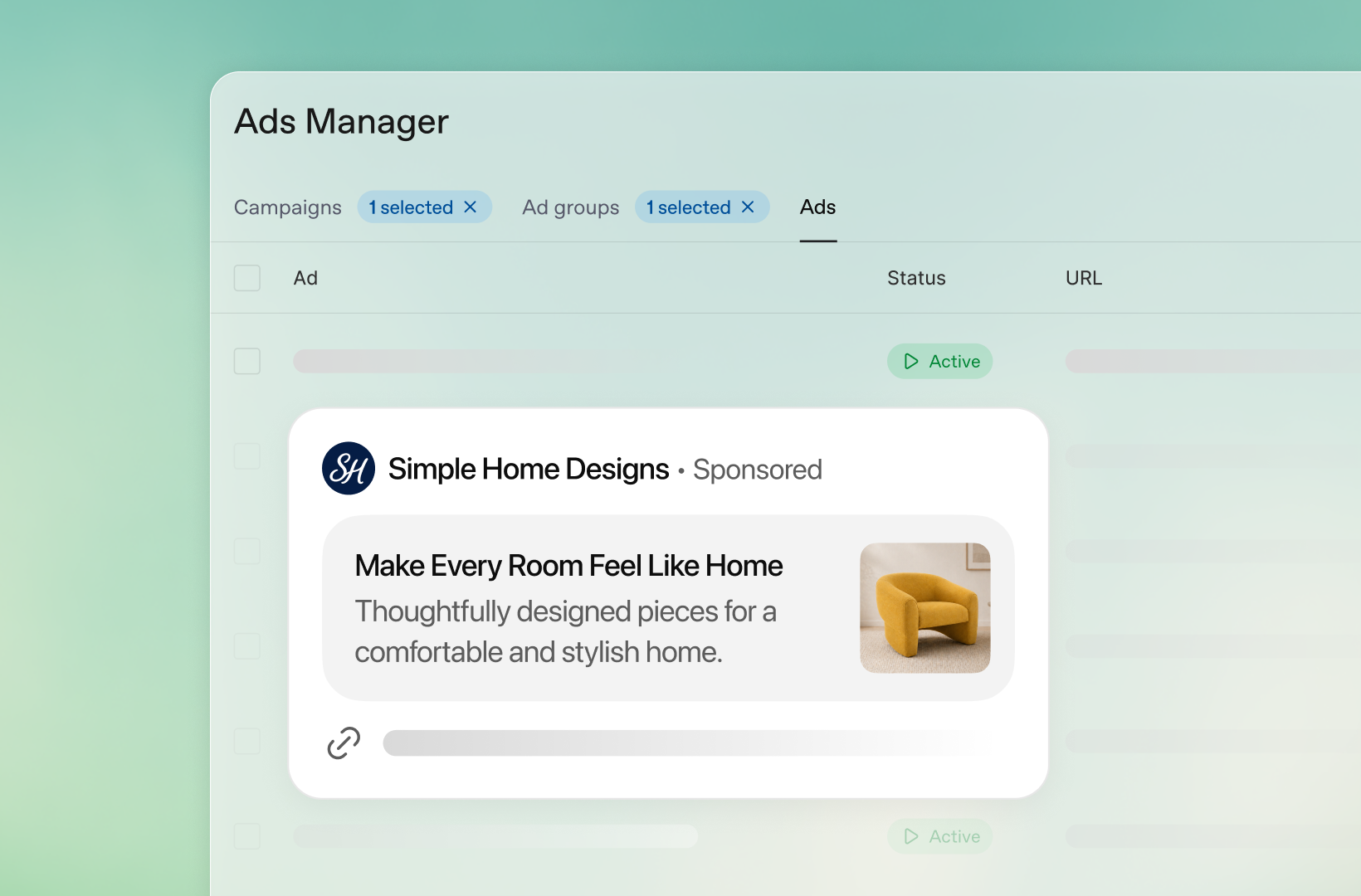
The 30-character headline, 60-character body copy, and single square image force creative to solve for one specific user question at a time, which breaks the “hero asset plus variations” approach most brands import from social.
Concrete requirements for the format include:
Brands running compressed messaging tests on Meta already have the raw material. Brands relying on brand-led creative built for Connected TV or out-of-home advertising will need net-new production.
OpenAI’s updated EU ads policy, effective from the 2nd of June, ties personalised ads to explicit opt-in consent rather than legitimate interest, which is likely to depress UK personalisation rates and inventory value relative to the US.
The US pilot ran in a permissive targeting environment. The UK is OpenAI’s first regulated market, and the mechanics are different. The target audience is split dynamically across two data pathways:
Consent rates on similar flows across the CMP (Content Management Platform) ecosystem typically sit well below 100%, which means a meaningful share of UK inventory will be contextual-only from day one.
For marketers, that is not a problem to solve, it is a channel characteristic to plan around. Contextual matching is what ChatGPT is genuinely good at. Brands with clear product-to-scenario mapping will outperform brands relying on audience data.
The ICO has not yet tested how it interprets past chat content or ChatGPT “memory” as targeting inputs. That regulatory uncertainty is a reason to lean on contextual creative strategy rather than personalisation-dependent bidding models, until the position clarifies.
The 30-character headline, 60-character body copy, and single square image force creative to solve for one specific user question at a time, which breaks the “hero asset plus variations” approach most brands import from social.
Concrete requirements for the format include:
Brands running compressed messaging tests on Meta already have the raw material. Brands relying on brand-led creative built for Connected TV or out-of-home advertising will need net-new production.
OpenAI has publicly projected $2.5 billion in ad revenue for 2026, scaling to $102 billion by 2030. The pace of geographic rollout confirms that ChatGPT ads are being built as a primary revenue line, rather than a supplementary experiment.
The company reported the ads business crossed $100 million in annualised revenue six weeks after the US consumer launch. That trajectory is why the UK go-live happened in June rather than 2027, and why self-serve, CPC bidding, conversion tracking, and CPA bidding have all shipped in sequence since May.
For UK marketing leaders, the planning implication is straightforward. This is not a channel to allocate against in 2027 budgets. It is a channel to run testing budget through in Q3 and Q4 of 2026, so that when self-serve opens and CPCs climb, you already know which product categories, prompts, and creative structures convert.
ChatGPT ads reward the brands that treat conversational context as a distinct creative and targeting discipline, not an extension of paid search. The UK pilot is short, rep-mediated, and unusually cheap to learn in. That combination will not last.
If you want to work through how ChatGPT ads fit alongside your existing search, social, and tracking activity, get in touch with our team at Sleeping Giant Media. In the meantime, keep learning with our library full of expertly-authored blogs, collection of free tools, and list of live events.
ChatGPT ads reward the brands that treat conversational context as a distinct creative and targeting discipline, not an extension of paid search. The UK pilot is short, rep-mediated, and unusually cheap to learn in. That combination will not last.
If you want to work through how ChatGPT ads fit alongside your existing search, social, and tracking activity, get in touch with our team at Sleeping Giant Media. In the meantime, keep learning with our library full of expertly-authored blogs, collection of free tools, and list of live events.
Ready for a digital marketing partner that delivers clear scoping, full transparency, and proven results? Fill out the form below to connect directly with the Sleeping Giant Media team and discover how we can help your business thrive.
AI-first search is changing how brands need to think about marketing budgets. Here’s how to rethink your investment across SEO, GEO, content, paid media and Digital PR.
ChatGPT Work and Claude Design 2.0 are changing how marketing teams create, automate and manage work. But as AI takes on more of the workflow, what happens to human oversight, brand ownership and compliance?
Reddit’s share of ChatGPT citations dropped by 86.4% in just four days. So, what happened? We look at what the change could mean for AI visibility, why relying too heavily on a single citation source creates risk, and what marketers should be doing to build a more resilient strategy.