
AI-first search is changing how brands need to think about marketing budgets. Here’s how to rethink your investment across SEO, GEO, content, paid media and Digital PR.

How To Build A Marketing Budget For An AI-First Search Landscape
read more
Performance Max, Demand Gen, and Meta’s Manus are changing how paid media platforms surface data and guide decision-making. While there is more visibility in some areas, much of what is provided still sits at a signal level rather than something directly actionable.
For paid teams, the focus now falls on interpreting that data carefully, maintaining control where needed, and building processes that support consistent performance.
Read on for the practical moves that preserve performance and guard brand equity.
You can now see where Performance Max serves (impressions by placement), but you cannot yet attribute conversions to those placements. So, it’s wise to simply use the data as direction, not proof.
Google has expanded PMAX reporting beyond the basics, giving advertisers visibility into where ads are being served. You can now review placements across YouTube, Google-owned channels, search partners, and the Display Network, alongside impression share by placement.
This added transparency is useful, particularly for understanding how the budget is being distributed, and for identifying potential brand safety concerns. However, it is important to recognise the current limitations of this data.
“Thankfully, Google has now been adding in more information so you can dive a bit deeper into what’s working.”
– Adam Howard, Paid Lead
At present, the interface only shows impressions by placement. There is no conversion-level attribution tied to these placements, which means you cannot draw direct conclusions about performance from this view alone.
There are also limits to control. Excluding a placement does not remove it entirely from the ecosystem, as delivery will simply shift to other available inventory. This makes exclusions more useful for managing risk than for improving performance outcomes.

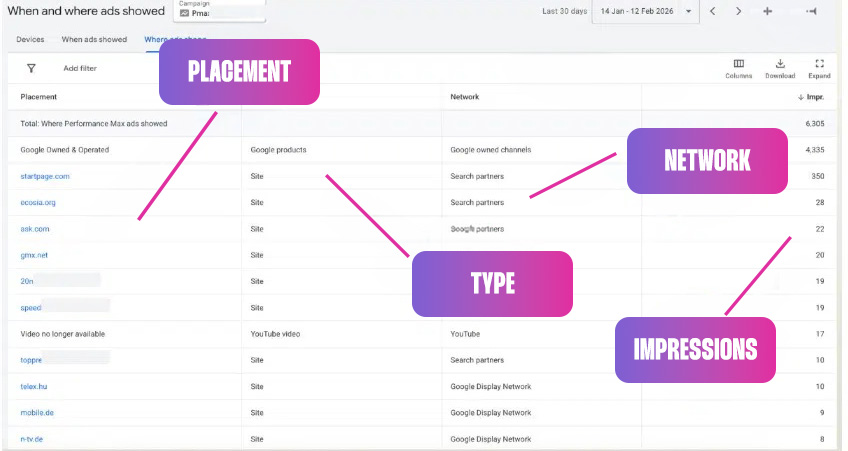
Rather than treating placement data as definitive, it is more effective to use it as a directional signal:
If you notice that a significant proportion of impressions are being delivered on a channel such as YouTube, it may be worth reassessing whether Performance Max aligns with your campaign objectives. In some cases, shifting budget into more controlled campaign types, such as dedicated Search or YouTube activity, can provide greater clarity.
You can now see where Performance Max serves (impressions by placement), but you cannot yet attribute conversions to those placements. So, it’s wise to simply use the data as direction, not proof.
Google has expanded PMAX reporting beyond the basics, giving advertisers visibility into where ads are being served. You can now review placements across YouTube, Google-owned channels, search partners, and the Display Network, alongside impression share by placement.
This added transparency is useful, particularly for understanding how the budget is being distributed, and for identifying potential brand safety concerns. However, it is important to recognise the current limitations of this data.
“Thankfully, Google has now been adding in more information so you can dive a bit deeper into what’s working.”
– Adam Howard, Paid Lead
At present, the interface only shows impressions by placement. There is no conversion-level attribution tied to these placements, which means you cannot draw direct conclusions about performance from this view alone.
There are also limits to control. Excluding a placement does not remove it entirely from the ecosystem, as delivery will simply shift to other available inventory. This makes exclusions more useful for managing risk than for improving performance outcomes.
Rather than treating placement data as definitive, it is more effective to use it as a directional signal:
If you notice that a significant proportion of impressions are being delivered on a channel such as YouTube, it may be worth reassessing whether Performance Max aligns with your campaign objectives. In some cases, shifting budget into more controlled campaign types, such as dedicated Search or YouTube activity, can provide greater clarity.
Lookalike audiences in Demand Gen now act as an observation signal rather than strict targeting, so monitoring performance and testing is essential.
Demand Gen’s approach to lookalike audiences has shifted. Instead of functioning as a fixed targeting method, lookalikes are now used as an AI-driven signal, similar to observation mode in search campaigns.
This change expands potential reach, but it can also reduce the level of precision that advertisers previously relied on. Campaigns that were built around tightly defined lookalike audiences may now be exposed to broader, less intent-driven users.
When lookalikes move from strict targeting to a signal-based approach, performance can change without any obvious adjustment in campaign setup.
You may see increases in volume alongside changes in conversion rate or cost per acquisition. If performance shifts unexpectedly, this change in how audiences are applied is a likely contributing factor.
A measured approach is key, focusing on monitoring and testing rather than immediate reaction.
“Targeting change could massively impact campaign performance.”
– Adam Howard, Paid Lead

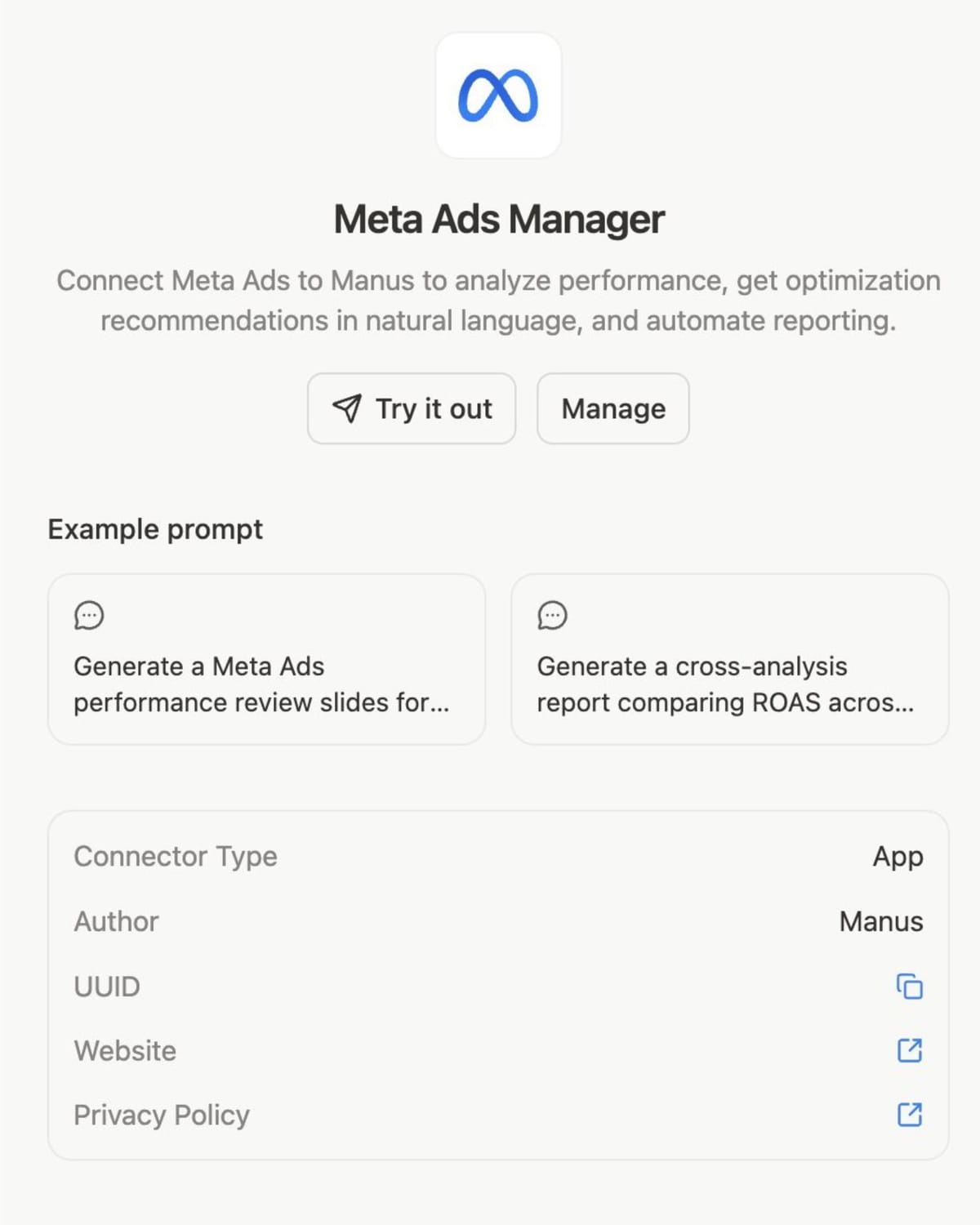
Meta’s Manus brings AI-driven reporting and optimisation suggestions directly into Ads Manager. It integrates with the Meta API to generate live insights and recommend changes across areas such as creative and targeting.
This reflects a broader move towards automation within platforms, with more of the executional workload being supported or handled by AI.
While Manus can improve efficiency, it also introduces a higher volume of automated recommendations. Many of these are designed to expand reach or activity, which may not always align with campaign goals. Without a review process, there is a risk that these changes could impact brand safety, or lead to an increase in lower-quality impressions.
To use Manus effectively, it should sit within a clear governance framework.
“[Meta’s] goal for advertising is to make it as streamlined as possible”
– Adam Howard, Paid Lead
When lookalikes move from strict targeting to a signal-based approach, performance can change without any obvious adjustment in campaign setup.
You may see increases in volume alongside changes in conversion rate or cost per acquisition. If performance shifts unexpectedly, this change in how audiences are applied is a likely contributing factor.
A measured approach is key, focusing on monitoring and testing rather than immediate reaction.
“Targeting change could massively impact campaign performance.”
– Adam Howard, Paid Lead
Meta’s Manus brings AI-driven reporting and optimisation suggestions directly into Ads Manager. It integrates with the Meta API to generate live insights and recommend changes across areas such as creative and targeting.
This reflects a broader move towards automation within platforms, with more of the executional workload being supported or handled by AI.
While Manus can improve efficiency, it also introduces a higher volume of automated recommendations. Many of these are designed to expand reach or activity, which may not always align with campaign goals. Without a review process, there is a risk that these changes could impact brand safety, or lead to an increase in lower-quality impressions.
To use Manus effectively, it should sit within a clear governance framework.
“[Meta’s] goal for advertising is to make it as streamlined as possible”
– Adam Howard, Paid Lead
Follow the tips below for a tactical response to Meta and Google’s AI changes:
These changes reward disciplined measurement and faster test cycles. Placement transparency, lookalike signal shifts and Manus automation all give you opportunities, but only if you treat platform outputs as signals, not verdicts.
If you want help turning these platform shifts into practical, measurable tests and controls, reach out to Sleeping Giant Media to discuss campaign governance, testing frameworks and channel-specific strategies. Contact the team to get started today.

These changes reward disciplined measurement and faster test cycles. Placement transparency, lookalike signal shifts and Manus automation all give you opportunities, but only if you treat platform outputs as signals, not verdicts.
If you want help turning these platform shifts into practical, measurable tests and controls, reach out to Sleeping Giant Media to discuss campaign governance, testing frameworks and channel-specific strategies. Contact the team to get started today.
Ready for a digital marketing partner that delivers clear scoping, full transparency, and proven results? Fill out the form below to connect directly with the Sleeping Giant Media team and discover how we can help your business thrive.
AI-first search is changing how brands need to think about marketing budgets. Here’s how to rethink your investment across SEO, GEO, content, paid media and Digital PR.

ChatGPT Work and Claude Design 2.0 are changing how marketing teams create, automate and manage work. But as AI takes on more of the workflow, what happens to human oversight, brand ownership and compliance?
Reddit’s share of ChatGPT citations dropped by 86.4% in just four days. So, what happened? We look at what the change could mean for AI visibility, why relying too heavily on a single citation source creates risk, and what marketers should be doing to build a more resilient strategy.