AI-first search is changing how brands need to think about marketing budgets. Here’s how to rethink your investment across SEO, GEO, content, paid media and Digital PR.

How To Build A Marketing Budget For An AI-First Search Landscape
read more
Google is quietly rebuilding the SERP into something closer to a social graph. Two new features, Preferred Sources and the soon-to-launch Search Profiles, are handing users the ability to follow brands inside search itself. What’s more, these features reward the brands that earn that loyalty with greater visibility in AI Overviews, AI Mode, and Google Discover/ Top Stories.
For marketing leaders, this is not another ranking tweak; it’s a change in how audience relationships translate into organic reach, and it deserves a place on the planning agenda now.
Google has spent the last two years reducing referral traffic to publishers and brands through AI summaries. Crucially, though, it is now offering a partial route back, but only to brands willing to actively cultivate first-party loyalty signals.
Preferred Sources and Search Profiles represent Google’s response to the loyalty problem that AI search created. How? By shifting organic visibility from a pure ranking contest to a question of followership and audience loyalty.
AI Overviews flattened brand differentiation. When a synthesised answer sits above ten blue links, the publisher behind the citation matters less than the citation itself.
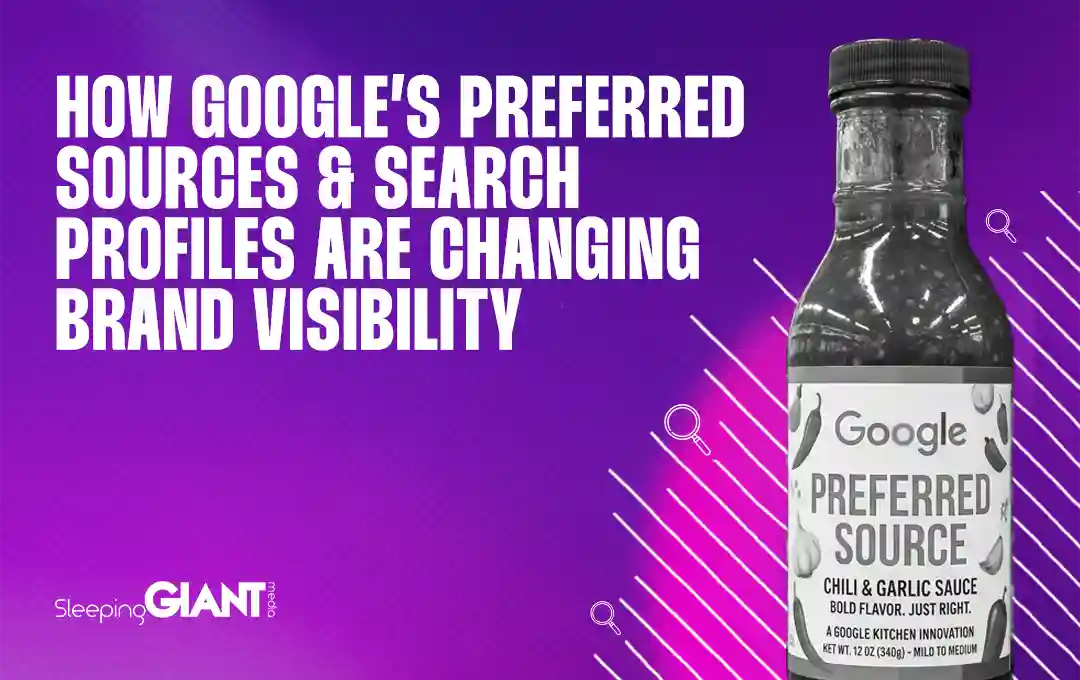
Preferred Sources, which expanded into AI Overviews and AI Mode in the UK in May 2026 partially reversed that. Users can now mark specific sites as ‘preferred’ in their Google settings, and those sites get a visible badge and prioritised placement inside AI responses and Top Stories.
“Google’s been working on and rolling out different features on the SERP that suggest they’re trying to give publishers more visibility and audiences more control over what they see.”
– Kitty Bushell, Content Manager, Sleeping Giant Media
The takeaway? Organic visibility is increasingly a direct product of audience loyalty, not just content quality or backlinks. If your SEO strategy still treats every user as anonymous, you are leaving a growing slice of AI-era reach on the table.

SEO Roundtable is reporting that users are roughly twice as likely to click a result marked as a Preferred Source. This reframes loyalty signals as a measurable CTR lever, not just a soft brand metric.
A doubled click-through rate on AI-adjacent placements is not marginal. It is the kind of uplift marketing leaders normally chase through bid increases or creative testing. The difference here is that the lever sits inside owned channels: email, on-site CTAs, and Google’s own downloadable button templates aimed at publishers.
The implication is that email lists and newsletter subscribers now have a second job. Beyond direct revenue, they are the most efficient route to securing preferred-source designation at scale. A campaign that converts 10% of an engaged newsletter base into Preferred Sources compounds across every relevant query that the audience runs for years afterwards.
Preferred Sources and Search Profiles represent Google’s response to the loyalty problem that AI search created. How? By shifting organic visibility from a pure ranking contest to a question of followership and audience loyalty.
AI Overviews flattened brand differentiation. When a synthesised answer sits above ten blue links, the publisher behind the citation matters less than the citation itself.
Preferred Sources, which expanded into AI Overviews and AI Mode in the UK in May 2026 partially reversed that. Users can now mark specific sites as ‘preferred’ in their Google settings, and those sites get a visible badge and prioritised placement inside AI responses and Top Stories.
“Google’s been working on and rolling out different features on the SERP that suggest they’re trying to give publishers more visibility and audiences more control over what they see.”
– Kitty Bushell, Content Manager, Sleeping Giant Media
The takeaway? Organic visibility is increasingly a direct product of audience loyalty, not just content quality or backlinks. If your SEO strategy still treats every user as anonymous, you are leaving a growing slice of AI-era reach on the table.
SEO Roundtable is reporting that users are roughly twice as likely to click a result marked as a Preferred Source. This reframes loyalty signals as a measurable CTR lever, not just a soft brand metric.
A doubled click-through rate on AI-adjacent placements is not marginal. It is the kind of uplift marketing leaders normally chase through bid increases or creative testing. The difference here is that the lever sits inside owned channels: email, on-site CTAs, and Google’s own downloadable button templates aimed at publishers.
The implication is that email lists and newsletter subscribers now have a second job. Beyond direct revenue, they are the most efficient route to securing preferred-source designation at scale. A campaign that converts 10% of an engaged newsletter base into Preferred Sources compounds across every relevant query that the audience runs for years afterwards.
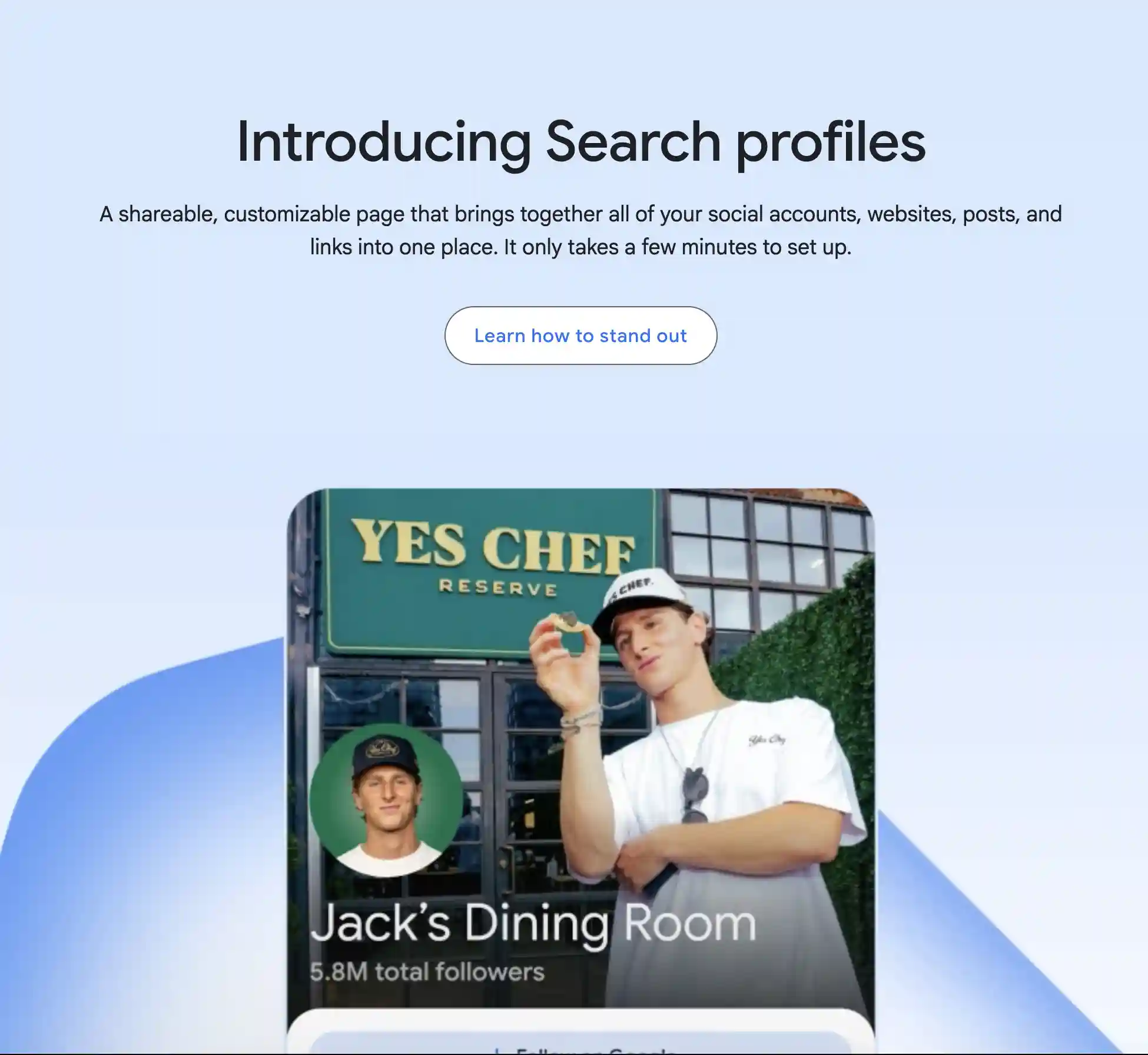
Enabling search profiles is only available for US accounts at this time, and requires 100,000 followers on YouTube, Instagram or X, or 300,000 on TikTok. This means that most UK brands should treat them as a watch-item and invest in entity optimisation now.
Google launched Search Profiles on 4 June 2026 in the US, giving eligible creators and publishers a claimable, shareable profile inside Search and Discover that connects directly to their Knowledge Panel. The follower thresholds are deliberately high. LinkedIn is not currently a qualifying platform, which is notable given how much B2B audience capital sits there.
For most UK marketing teams, the realistic short-term strategy will not be the Search Profile itself. Instead, it’ll be the underlying entity graph that powers the Knowledge Panel. Structured data, consistent entity signals across owned properties, and a verified Knowledge Panel deliver much of the same visibility benefit without the follower gate.
When Search Profiles roll out internationally, and the thresholds inevitably soften, brands with a strong entity foundation will be able to claim theirs quickly. Brands without one will spend six months catching up. As Kitty observed:
“Google is seeing that search on social is performing really well. People are using things like TikTok as a search engine. I think they’re trying to tap into that by giving a search engine an almost special profile-like presence for certain brands.”
– Kitty Bushell, Content Manager, Sleeping Giant Media
That framing matters. Search Profiles may well be Google defending against TikTok and Instagram as discovery engines. The brands Google wants to surface are the ones already winning attention off-platform. Social reach is now an SEO input.
Google has not yet confirmed whether brands will be able to see how many users have marked them as a Preferred Source, which leaves a meaningful attribution gap that marketing teams need to plan around.
If and when that metric is exposed, it becomes one of the cleanest retention signals available: a user actively choosing your brand inside Google’s own interface.
Until then, the proxy measurements worth setting up are click-through on the preferred-source CTA in emails and on-site, plus branded query volume and AI Overview citation share tracked through tools like Scrunch (or Google’s own Search Console when the capabilities advance).
The wider point is that the metrics that count for organic are changing. Impressions and clicks in Search Console only capture part of the picture once AI Overviews, Preferred Source badges, and Search Profiles are in play. Leaders who do not update their reporting frameworks will misread performance and underinvest in the activities that now matter most.

The brands that will benefit most from Google’s new loyalty features are those already creating content their audiences actively choose to follow—and with the CRM and lifecycle marketing in place to turn that loyalty into Preferred Source designations. Everyone else will be optimising for a search landscape that increasingly rewards relationships they haven’t invested in building.
If you want a sharper view of what this means for your content, SEO and lifecycle strategy, get in touch with the Content and SEO experts at Sleeping Giant Media.
For more resources and guidance, keep up to date with our blog or sign up to one of our exclusive marketing leadership events.
Google has not yet confirmed whether brands will be able to see how many users have marked them as a Preferred Source, which leaves a meaningful attribution gap that marketing teams need to plan around.
If and when that metric is exposed, it becomes one of the cleanest retention signals available: a user actively choosing your brand inside Google’s own interface.
Until then, the proxy measurements worth setting up are click-through on the preferred-source CTA in emails and on-site, plus branded query volume and AI Overview citation share tracked through tools like Scrunch (or Google’s own Search Console when the capabilities advance).
The wider point is that the metrics that count for organic are changing. Impressions and clicks in Search Console only capture part of the picture once AI Overviews, Preferred Source badges, and Search Profiles are in play. Leaders who do not update their reporting frameworks will misread performance and underinvest in the activities that now matter most.
The brands that will benefit most from Google’s new loyalty features are those already creating content their audiences actively choose to follow—and with the CRM and lifecycle marketing in place to turn that loyalty into Preferred Source designations. Everyone else will be optimising for a search landscape that increasingly rewards relationships they haven’t invested in building.
If you want a sharper view of what this means for your content, SEO and lifecycle strategy, get in touch with the Content and SEO experts at Sleeping Giant Media.
For more resources and guidance, keep up to date with our blog or sign up to one of our exclusive marketing leadership events.
Ready for a digital marketing partner that delivers clear scoping, full transparency, and proven results? Fill out the form below to connect directly with the Sleeping Giant Media team and discover how we can help your business thrive.
AI-first search is changing how brands need to think about marketing budgets. Here’s how to rethink your investment across SEO, GEO, content, paid media and Digital PR.
ChatGPT Work and Claude Design 2.0 are changing how marketing teams create, automate and manage work. But as AI takes on more of the workflow, what happens to human oversight, brand ownership and compliance?
Reddit’s share of ChatGPT citations dropped by 86.4% in just four days. So, what happened? We look at what the change could mean for AI visibility, why relying too heavily on a single citation source creates risk, and what marketers should be doing to build a more resilient strategy.