AI-first search is changing how brands need to think about marketing budgets. Here’s how to rethink your investment across SEO, GEO, content, paid media and Digital PR.
How To Build A Marketing Budget For An AI-First Search Landscape
read more
The industry’s reaction to Google’s testing of hover cards (or ‘contextual overlay link cards’) in AI Overviews has been overwhelmingly positive. Brand logos in citations. Expanded source panels on hover. Finally, some visibility for the sites feeding Google’s AI answers. But the optimism misses what might actually be happening: Google is making the SERP stickier, not more generous.
The same update that gives your brand a favicon and a description in a hover panel may also be removing the last remaining reason for a user to click through to your site. Meanwhile, Google’s own properties are quietly absorbing a growing share of AI mode citations, creating a walled garden that rewards brands already playing on Google’s platforms while squeezing out those relying solely on their own domains.
Some people argue that hover cards are affording cited brands more organic exposure. However, at the same time, these link cards shift user behaviour from “click to explore” to “hover to explore”, which is likely to suppress click-through rates further rather than recover them.
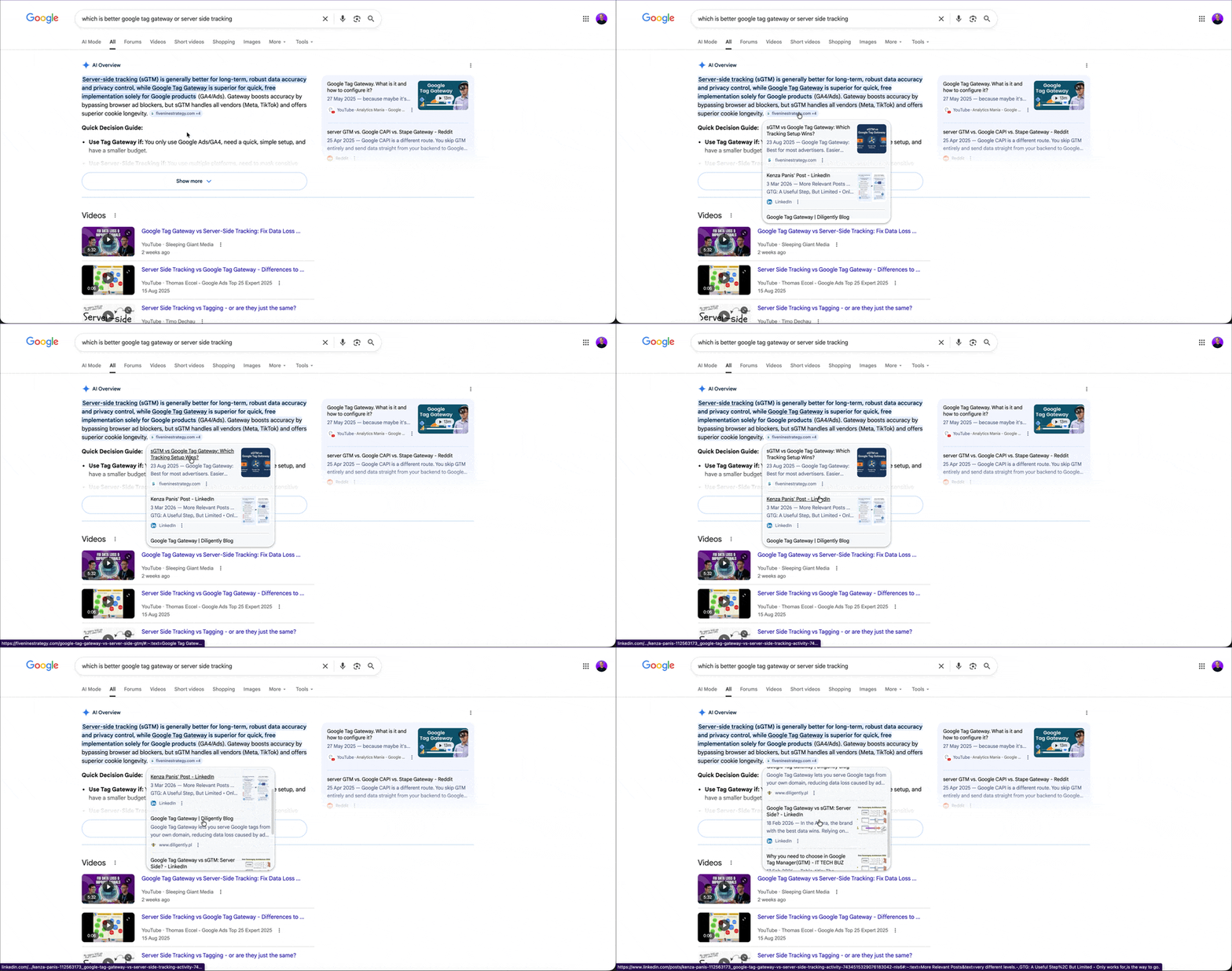
Google’s new hover pop-up link cards display the source’s site name, favicon, and a short description when a desktop user moves their cursor over a citation in AI Overviews. Announced by Robby Stein, Google’s VP of Search, the feature is positioned as a way to make source links “more visible and engaging”. The SEO community has largely received it as a concession from Google, a nod towards the publishers whose content powers these AI-generated answers.
The problem is that the feature provides just enough information to satisfy curiosity without requiring a click. Before hover cards, a user might have clicked through to verify a source or explore further. Now, the brand name, icon, and summary are surfaced directly on the SERP. The decision-making moves upstream, and for most queries, the answer is “I’ve seen enough.”
“These hover cards shift the decision-making from a ‘click to explore’ to a ‘hover to explore.’ […] I think it’s keeping brands on the page rather than sending them off further.”
— Kitty Bushell, Content Manager
This matters when you consider the baseline. Ahrefs reported in late 2025 that AI Overviews reduce click-through rates for position one content by 58%. As well as this, Seer Interactive’s research found a 61% drop in organic CTR for informational queries with AI Overviews. Hover cards are emerging in an environment where clicks were already in freefall. Framing them as a recovery mechanism might not be the right thing to do.
Treat hover cards as a brand impression channel, not a traffic driver. If your brand is being cited, the hover card becomes a micro-touchpoint. That makes metadata quality commercially important in a way it previously was not. Write meta descriptions that assert authority and specificity, not just keyword relevance. A description that reads like a credentials statement will outperform a generic summary when it’s the only thing a user sees before moving on.

Google’s self-citation rate in AI mode has tripled to 17.42% of all citations, and the majority now point to Google’s own search results rather than external sites.
The composition of those self-citations has also shifted:
This creates a loop. A user asks a question in AI mode, receives a synthesised answer, sees citations that lead back into Google Search, and encounters another set of results, all without leaving Google’s ecosystem. For publishers, the implication is stark: even when your content contributes to an AI answer, the citation link might bypass your site entirely in favour of a Google results page that happens to include you.
“Google’s giving with one hand and saying, ‘Here’s some more visibility’. But also it’s taking with the other, because it’s reserving a lot of the actual spots in sources for its own properties.”
— Kitty Bushell, Content Manager
Audit where your brand appears across Google-owned properties. YouTube, Google Business Profile, and Google’s organic index are all citation sources. If your Google Business Profile is outdated or your brand has no YouTube presence, you’re invisible in the fastest-growing citation category. This is not about pivoting your entire strategy. It is about closing gaps that are now commercially consequential.
Some people argue that hover cards are affording cited brands more organic exposure. However, at the same time, these link cards shift user behaviour from “click to explore” to “hover to explore”, which is likely to suppress click-through rates further rather than recover them.
Google’s new hover pop-up link cards display the source’s site name, favicon, and a short description when a desktop user moves their cursor over a citation in AI Overviews. Announced by Robby Stein, Google’s VP of Search, the feature is positioned as a way to make source links “more visible and engaging”. The SEO community has largely received it as a concession from Google, a nod towards the publishers whose content powers these AI-generated answers.
The problem is that the feature provides just enough information to satisfy curiosity without requiring a click. Before hover cards, a user might have clicked through to verify a source or explore further. Now, the brand name, icon, and summary are surfaced directly on the SERP. The decision-making moves upstream, and for most queries, the answer is “I’ve seen enough.”
“These hover cards shift the decision-making from a ‘click to explore’ to a ‘hover to explore.’ […] I think it’s keeping brands on the page rather than sending them off further.”
— Kitty Bushell, Content Manager
This matters when you consider the baseline. Ahrefs reported in late 2025 that AI Overviews reduce click-through rates for position one content by 58%. As well as this, Seer Interactive’s research found a 61% drop in organic CTR for informational queries with AI Overviews. Hover cards are emerging in an environment where clicks were already in freefall. Framing them as a recovery mechanism might not be the right thing to do.
Treat hover cards as a brand impression channel, not a traffic driver. If your brand is being cited, the hover card becomes a micro-touchpoint. That makes metadata quality commercially important in a way it previously was not. Write meta descriptions that assert authority and specificity, not just keyword relevance. A description that reads like a credentials statement will outperform a generic summary when it’s the only thing a user sees before moving on.
Google’s self-citation rate in AI mode has tripled to 17.42% of all citations, and the majority now point to Google’s own search results rather than external sites.
The composition of those self-citations has also shifted:
This creates a loop. A user asks a question in AI mode, receives a synthesised answer, sees citations that lead back into Google Search, and encounters another set of results, all without leaving Google’s ecosystem. For publishers, the implication is stark: even when your content contributes to an AI answer, the citation link might bypass your site entirely in favour of a Google results page that happens to include you.
“Google’s giving with one hand and saying, ‘Here’s some more visibility’. But also it’s taking with the other, because it’s reserving a lot of the actual spots in sources for its own properties.”
— Kitty Bushell, Content Manager
Audit where your brand appears across Google-owned properties. YouTube, Google Business Profile, and Google’s organic index are all citation sources. If your Google Business Profile is outdated or your brand has no YouTube presence, you’re invisible in the fastest-growing citation category. This is not about pivoting your entire strategy. It is about closing gaps that are now commercially consequential.
59% of Google’s AI mode self-citations still point to organic search results, which means traditional SEO performance remains the single largest factor in AI mode visibility.
There is a temptation to read the self-citation data and conclude that the answer is to go all-in on YouTube and Google Business Profile optimisation. But that would be focusing on just one side of the picture.
The SE Ranking data shows that organic results remain the dominant citation source in AI mode, both from Google’s own self-referencing links and from third-party citations. Brands that rank well organically are more likely to be cited in AI-generated answers, regardless of how the citation is ultimately displayed to the user.
The smarter move is to treat Google-owned platforms as amplifiers of an organic strategy rather than replacements for one. If you already produce high-quality written content, repurposing key pieces into short-form video for YouTube or updating your Google Business Profile with fresh posts and media creates additional citation surfaces without diverting resources from what already works.
| Content type | Role in AI mode visibility | Importance |
| Organic content and on-page SEO | Primary citation source (59% of Google self-citations reference organic results) | High |
| YouTube and short-form video | Growing citation source within Google’s self-referencing | Medium |
| Google Business Profile | Relevant for local and branded queries | Medium |
| Metadata optimisation | Directly impacts hover card presentation (but can be changed by Google) | Medium |
“Organic visibility, how you’re ranking, does matter within AI summaries. It is still important to produce content as you would normally, not just pivoting completely to Google-owned optimisation.”
— Kitty Bushell, Content Manager
As Google continues to tweak its AI summaries and how sources appear, the brands that will maintain visibility are those with agile content strategies. It’s crucial to nail the basics, but also treat generative engine optimisation (GEO) as an extension of your existing content work, not a separate discipline.
That means writing content that establishes clear authority signals, structuring it for AI summarisation, and ensuring your brand is represented consistently across the platforms Google is drawing from.
If you want to understand how your content is performing in AI search and where the gaps are, get in touch with Sleeping Giant Media today. We work with brands to build content and SEO strategies that account for where search is heading, not just where it has been.
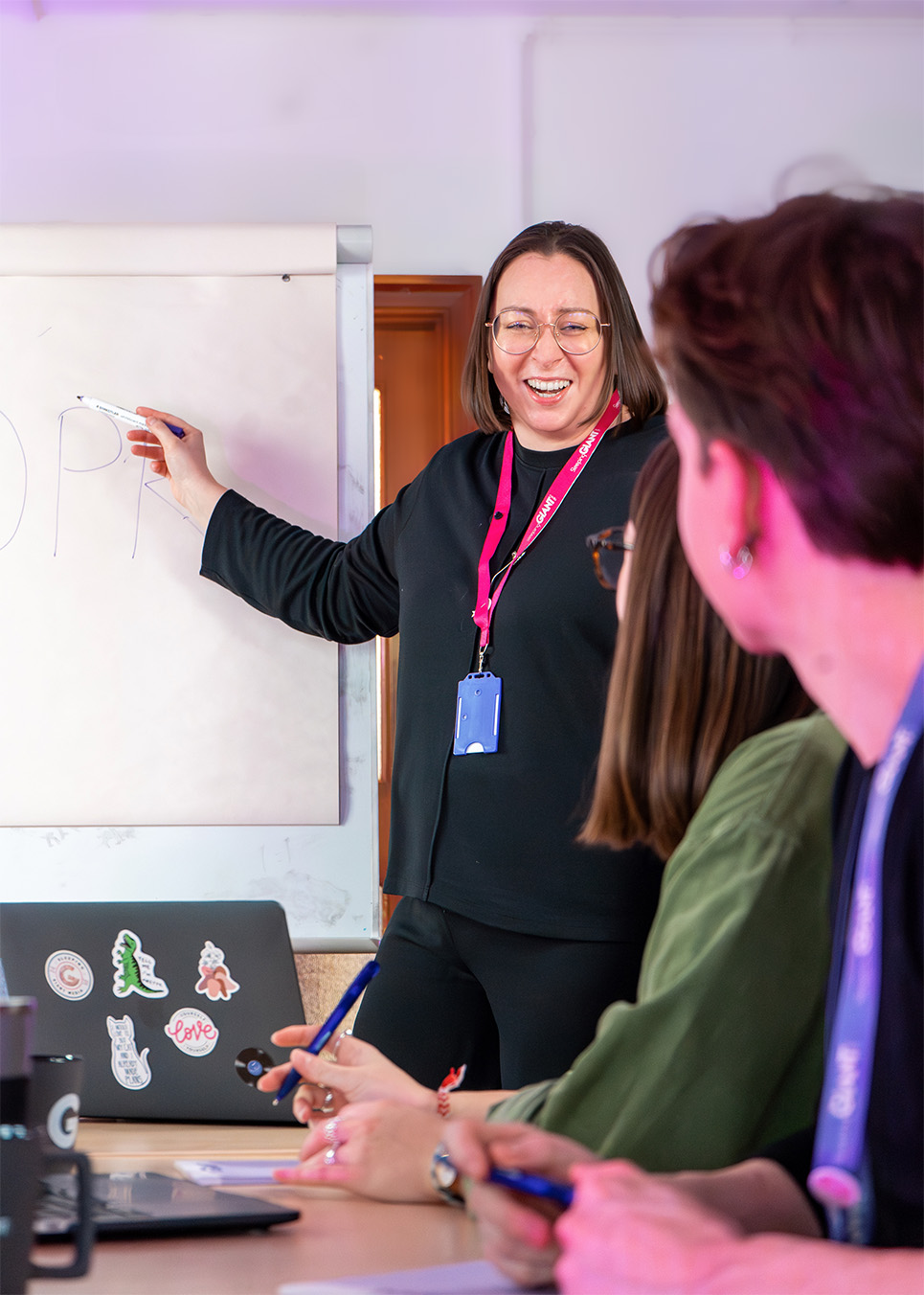
As Google continues to tweak its AI summaries and how sources appear, the brands that will maintain visibility are those with agile content strategies. It’s crucial to nail the basics, but also treat generative engine optimisation (GEO) as an extension of your existing content work, not a separate discipline.
That means writing content that establishes clear authority signals, structuring it for AI summarisation, and ensuring your brand is represented consistently across the platforms Google is drawing from.
If you want to understand how your content is performing in AI search and where the gaps are, get in touch with Sleeping Giant Media today. We work with brands to build content and SEO strategies that account for where search is heading, not just where it has been.
Ready for a digital marketing partner that delivers clear scoping, full transparency, and proven results? Fill out the form below to connect directly with the Sleeping Giant Media team and discover how we can help your business thrive.
AI-first search is changing how brands need to think about marketing budgets. Here’s how to rethink your investment across SEO, GEO, content, paid media and Digital PR.
ChatGPT Work and Claude Design 2.0 are changing how marketing teams create, automate and manage work. But as AI takes on more of the workflow, what happens to human oversight, brand ownership and compliance?
Reddit’s share of ChatGPT citations dropped by 86.4% in just four days. So, what happened? We look at what the change could mean for AI visibility, why relying too heavily on a single citation source creates risk, and what marketers should be doing to build a more resilient strategy.