AI-first search is changing how brands need to think about marketing budgets. Here’s how to rethink your investment across SEO, GEO, content, paid media and Digital PR.
How To Build A Marketing Budget For An AI-First Search Landscape
read more
Google’s launch of AI Brief inside AI Max is a game-changing feature update for digital advertisers. Powered by Gemini, AI Brief offers an innovative way for paid marketers to steer AI Max by providing context on their business, goals, and audience in their own words.
The competitive edge is no longer in how exhaustively your team enumerates keyword variations; it’s in how precisely you can articulate commercial intent to a system that now interprets meaning, rather than matches strings.
Let’s take a closer look at the significant changes and opportunities AI Brief can bring to PPC marketing.
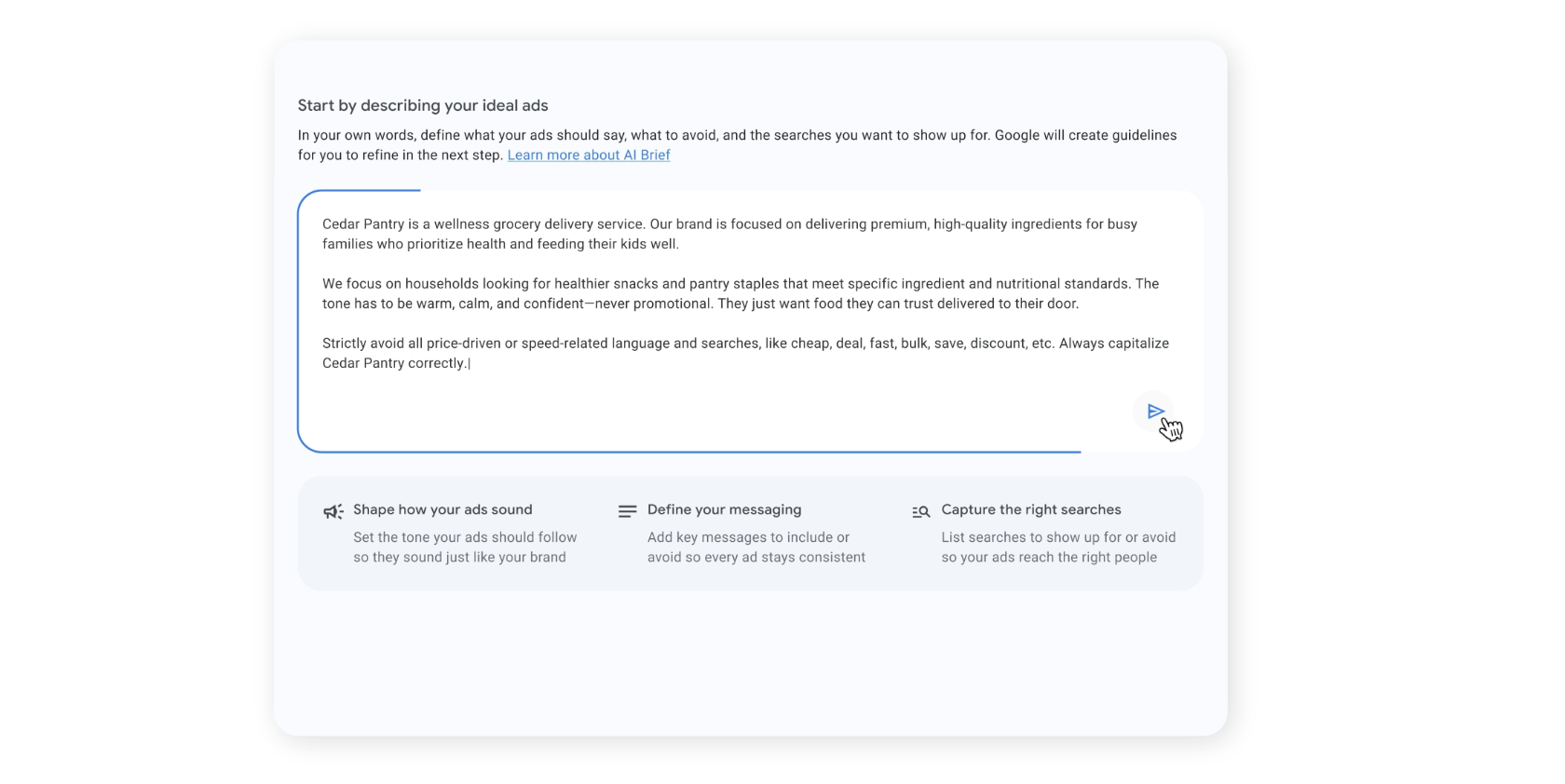
AI Brief is a Gemini-powered instruction layer that lets advertisers steer AI Max using natural language across three dimensions:
Existing text guidelines will automatically migrate into the messaging section, which tells you exactly where Google sees this going. As you prompt, Gemini delivers sample assets as examples to steer further refinement before you commit. Looking ahead, this written brief format may well become the primary interface for advertiser control inside automated search.

Some marketers suggest that AI Brief exists because Google has run out of ways to defend automation without giving advertisers a credible mechanism to express business context – and natural language is the only input flexible enough to carry it. We might just agree with that sentiment.
The objection to AI-led search has never really been about automation in principle. Most performance teams will hand over bid logic, asset rotation, and even match-type interpretation when the numbers justify it. The objection has been about strategic legibility:
Google’s previous answer was indirect: feed it better assets, tighten exclusions, and improve the landing page. But, now, AI Brief offers a direct answer. You can now tell the system, in writing, what your business actually is.
That matters because the inputs Google has historically prioritised – namely keywords, assets, and historical conversion data – are structurally incapable of carrying nuance like “we don’t compete on price” or “student research traffic looks qualified but never closes”. AI Brief is designed to carry exactly that.
“AI Brief changes how you guide a campaign from the start […]. Advertisers can describe their business, their audiences, and their brand guidelines in their own words, directly to AI, just like you’d do if you were briefing a partner.”
Brandon Ervin, Director of Product Management, Google Ads.
AI Brief is a Gemini-powered instruction layer that lets advertisers steer AI Max using natural language across three dimensions:
Existing text guidelines will automatically migrate into the messaging section, which tells you exactly where Google sees this going. As you prompt, Gemini delivers sample assets as examples to steer further refinement before you commit. Looking ahead, this written brief format may well become the primary interface for advertiser control inside automated search.
Some marketers suggest that AI Brief exists because Google has run out of ways to defend automation without giving advertisers a credible mechanism to express business context – and natural language is the only input flexible enough to carry it. We might just agree with that sentiment.
The objection to AI-led search has never really been about automation in principle. Most performance teams will hand over bid logic, asset rotation, and even match-type interpretation when the numbers justify it. The objection has been about strategic legibility:
Google’s previous answer was indirect: feed it better assets, tighten exclusions, and improve the landing page. But, now, AI Brief offers a direct answer. You can now tell the system, in writing, what your business actually is.
That matters because the inputs Google has historically prioritised – namely keywords, assets, and historical conversion data – are structurally incapable of carrying nuance like “we don’t compete on price” or “student research traffic looks qualified but never closes”. AI Brief is designed to carry exactly that.
“AI Brief changes how you guide a campaign from the start […]. Advertisers can describe their business, their audiences, and their brand guidelines in their own words, directly to AI, just like you’d do if you were briefing a partner.”
Brandon Ervin, Director of Product Management, Google Ads.
Matching guidelines are the most commercially significant part of AI Brief, because they let advertisers describe intent quality at a level that negative keyword lists have struggled to express.
Most paid search waste sits in adjacent intent, not irrelevant intent. For example:
These aren’t problems you solve with negatives, because the bad traffic doesn’t share predictable terms with the good; it shares a mindset. Matching guidelines let you describe that mindset. Google’s own example: “prioritise searches for healthy pantry staples”, is deliberately fuzzy in a way a keyword list can’t be (which is exactly the point!).
For paid marketing leaders, this reframes the negative keyword conversation entirely. The question stops being “what queries should we block” and becomes “what commercial intent should we describe as in-scope”. Teams should be auditing the past 90 days of converted-but-low-value traffic and turning those patterns into matching guidance, not just adding them to a negatives list that grows indefinitely.
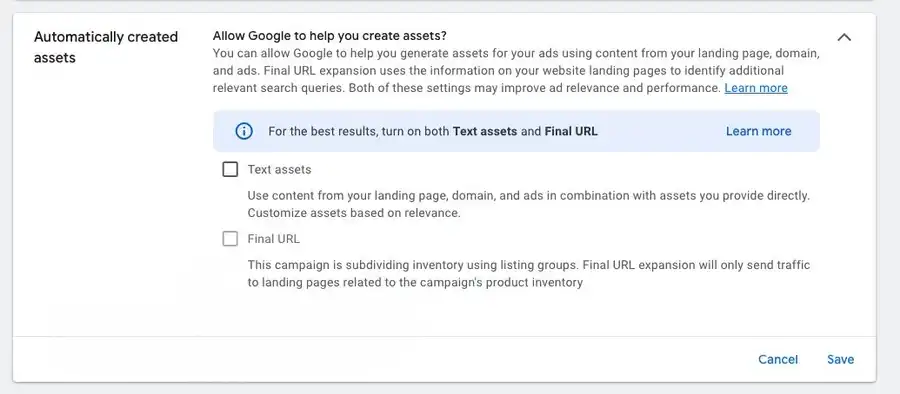
Is Final URL Expansion the lever everyone is underestimating? It is doing more to determine AI Max performance than AI Brief itself, and yet most advertisers haven’t audited their site for it.
AI Brief gets the announcement coverage, but Final URL Expansion may well be where performance is actually won or lost. If Google is sending traffic to whichever page on your domain best matches a query, then every thin product page, every outdated service description, every orphaned blog post is now a potential landing page for traffic you’re paying for (unless you manually exclude certain pages).
Think of it like this: AI Brief tells the system what to say, Final URL Expansion decides where the user lands.
This is where the “regulated industry” caveat becomes interesting for everyone, not just healthcare and finance. The new text disclaimers feature, which guarantees mandatory text appears in ads even when FUE is active, removes the last operational reason for cautious advertisers to keep FUE switched off. As such, we can expect adoption to accelerate sharply across insurance, legal, financial services, and healthcare over the coming months.
Before activating AI Brief, commission a page eligibility audit. Identify which URLs should be included in Final URL Expansion, which should be excluded, and which pages are commercially unfit for paid traffic regardless of how well they match a query. If you don’t control this, AI Brief may well be writing ads that route users to your weakest pages.

As Google continues to automate elements of campaign management, agency value may increasingly shift away from campaign construction towards strategic interpretation.
Tasks such as keyword expansion, ad variation, and destination selection are becoming more automated, which could reduce the emphasis placed on some of the manual processes that have traditionally formed part of PPC management.
That doesn’t mean expertise becomes less important. Instead, it may place greater emphasis on areas that are harder to automate, such as customer research, positioning, audience understanding, intent mapping, exclusion strategies, landing page evaluation, and performance diagnosis. These are often the areas where experienced PPC teams can provide the most meaningful input.
Is Final URL Expansion the lever everyone is underestimating? It is doing more to determine AI Max performance than AI Brief itself, and yet most advertisers haven’t audited their site for it.
AI Brief gets the announcement coverage, but Final URL Expansion may well be where performance is actually won or lost. If Google is sending traffic to whichever page on your domain best matches a query, then every thin product page, every outdated service description, every orphaned blog post is now a potential landing page for traffic you’re paying for (unless you manually exclude certain pages).
Think of it like this: AI Brief tells the system what to say, Final URL Expansion decides where the user lands.
This is where the “regulated industry” caveat becomes interesting for everyone, not just healthcare and finance. The new text disclaimers feature, which guarantees mandatory text appears in ads even when FUE is active, removes the last operational reason for cautious advertisers to keep FUE switched off. As such, we can expect adoption to accelerate sharply across insurance, legal, financial services, and healthcare over the coming months.
Before activating AI Brief, commission a page eligibility audit. Identify which URLs should be included in Final URL Expansion, which should be excluded, and which pages are commercially unfit for paid traffic regardless of how well they match a query. If you don’t control this, AI Brief may well be writing ads that route users to your weakest pages.
As Google continues to automate elements of campaign management, agency value may increasingly shift away from campaign construction towards strategic interpretation.
Tasks such as keyword expansion, ad variation, and destination selection are becoming more automated, which could reduce the emphasis placed on some of the manual processes that have traditionally formed part of PPC management.
That doesn’t mean expertise becomes less important. Instead, it may place greater emphasis on areas that are harder to automate, such as customer research, positioning, audience understanding, intent mapping, exclusion strategies, landing page evaluation, and performance diagnosis. These are often the areas where experienced PPC teams can provide the most meaningful input.
The misconception worth correcting directly: AI Brief does not reduce the need for paid search expertise. It relocates it. The teams that win the next 18 months in search will be the ones who measure business value accurately, write briefs with precision, and maintain websites that deserve the traffic AI Max sends them.
If you’d like a view on whether your current search setup is ready for AI Brief, or you want a second opinion on how to structure the test, get in touch with the Paid Media experts at Sleeping Giant Media.
And, for more cutting-edge insights and takeaways from the latest changes in PPC, Paid Social, SEO, Digital PR, and Content Marketing, keep up to date with our blog and schedule of free events.
Ready for a digital marketing partner that delivers clear scoping, full transparency, and proven results? Fill out the form below to connect directly with the Sleeping Giant Media team and discover how we can help your business thrive.
AI-first search is changing how brands need to think about marketing budgets. Here’s how to rethink your investment across SEO, GEO, content, paid media and Digital PR.
ChatGPT Work and Claude Design 2.0 are changing how marketing teams create, automate and manage work. But as AI takes on more of the workflow, what happens to human oversight, brand ownership and compliance?
Reddit’s share of ChatGPT citations dropped by 86.4% in just four days. So, what happened? We look at what the change could mean for AI visibility, why relying too heavily on a single citation source creates risk, and what marketers should be doing to build a more resilient strategy.