
AI-first search is changing how brands need to think about marketing budgets. Here’s how to rethink your investment across SEO, GEO, content, paid media and Digital PR.

How To Build A Marketing Budget For An AI-First Search Landscape
read more
The EU has stopped talking about AI transparency and started enforcing it. From the 2nd of August, Article 50 of the AI Act puts real disclosure duties on the AI systems most marketing teams have quietly run for the past two years. Chatbots, generative creative, biometric personalisation: all of it is in scope.
The Commission adopted its final guidelines on the 20th of July, so the rules are no longer up for debate.
The full guidelines are public now, and they set the bar higher than most brands and agencies expect. Where you’re based makes no difference, either: If EU users see your content, you’re in scope.
The uncomfortable reality is that most in-house setups were never built for this technological seismic shift, because nobody really owns it. The responsibility is spread across the agency, the platform, the martech vendor, and the internal team, and everyone assumes someone else has it handled.
With days left on the clock, the task is easy to describe and harder to do: find every area you use AI, and work out which rule it trips, if any.
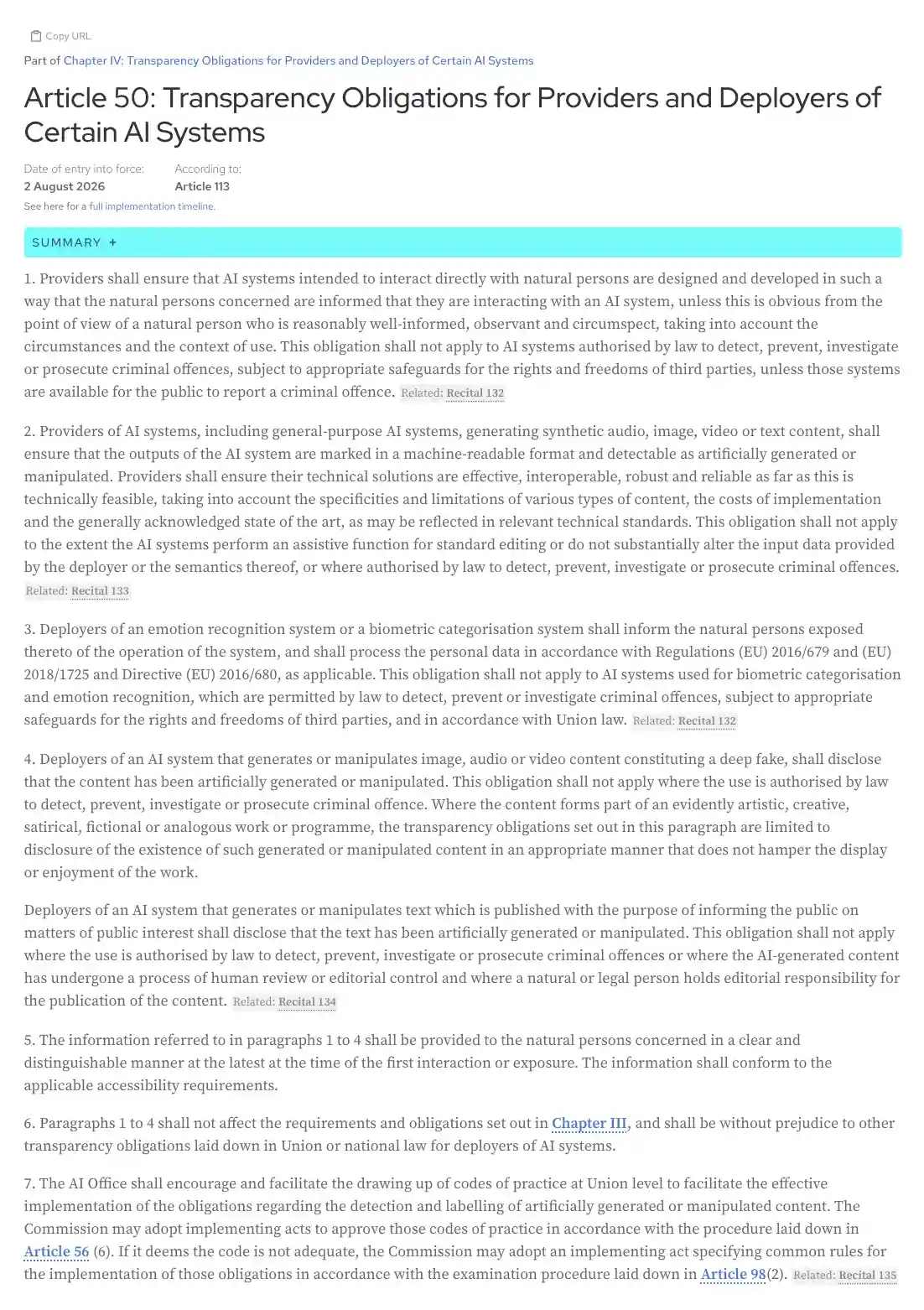

It comes down to how much you touch these tools. Use it off the shelf, and you’re a deployer. Rebrand it, fine-tune it, or build it into your own product, and you can tip over into being its provider, which carries the heavier weight of responsibility.
This is the part that can trip agencies up. The assumption is that because you’re using OpenAI, Synthesia, or ElevenLabs, the transparency duty is theirs. Sometimes it is. But responsibility follows the value chain, and the moment you put your own name on a generative tool, or change its output in a meaningful way, some of that duty lands on you.
So, audit every AI touchpoint and label each one: provider, deployer, or both. Legal can advise, but marketing ops should own the list.
A robotic name or a digital avatar doesn’t cut it. The disclosure has to be spelled out; it has to land on the first interaction, and it has to work for screen readers.
Plenty of teams tell themselves that people already know they’re talking to a bot, because it’s sitting in a chat widget or it’s got an obviously robotic name. The guidance shuts that down.
Whether the customer ‘knew’ isn’t the test. The test is whether you told them, clearly, up front, in a way that’s accessible, which in practice means meeting the Web Content Accessibility Guidelines (WCAG). It only applies, however, when the AI is actually speaking to a person. AI working away in the background doesn’t trigger it.
There’s a sting in the tail here for anyone chasing conversion – a lot of brands have spent the past year making assistants feel more human precisely because it may bring engagement up, and now, this investment could be a liability rather than a benefit.
On your adverts, you can say this was produced with AI. But again, that is not a sort of a catch-all… just by slapping that on there doesn’t mean that that’s now legally compliant. You know, you can’t get away with just producing random images that don’t represent your product as well.
– Luke Quilter, CEO, Sleeping Giant Media
If it’s AI-made or AI-altered and it shows real or realistic people, places or events, it needs a label a person can actually see. A tag buried in the file isn’t enough on its own.
This is where creative and brand teams feel it most. Synthetic voiceover, AI product shots, virtual presenters, AI-cloned ambassadors: all of them count as deepfakes under the new EU rules, and all of them need disclosure. A Coalition for Content Provenance and Authenticity (C2PA) credential in the metadata is good practice, but by itself it doesn’t discharge the AI deployer’s duty.
There’s an exception for art and satire, but it’s narrow, and it won’t stretch far enough to cover most advertising or marketing team activities. If you’re leaning on AI to keep production costs down, budget for a visible on-creative label, and check whether the labels Meta, TikTok and YouTube apply are enough, or whether you still need your own mark on the asset.


AI-written content becomes a ‘matter of public interest’ at the moment it’s meant to inform the public on things like politics, health, money, consumer safety or the environment. Then it needs a label, unless a named human genuinely reviewed it and will stand behind it.
If you’re running programmatic SEO, or turning out AI thought leadership at volume, this is a problem. The whole point of that model was to strip out the human editorial cost, and Article 50 puts a floor back under it. The likely result is a split: proper human-owned editorial for anything that touches public interest, and clearly labelled AI content for everything else.
There’s a whole piece around this accountability, I would say, and transparency is really, really important.
-Luke Quilter, CEO, Sleeping Giant Media
If it’s AI-made or AI-altered and it shows real or realistic people, places or events, it needs a label a person can actually see. A tag buried in the file isn’t enough on its own.
This is where creative and brand teams feel it most. Synthetic voiceover, AI product shots, virtual presenters, AI-cloned ambassadors: all of them count as deepfakes under the new EU rules, and all of them need disclosure. A Coalition for Content Provenance and Authenticity (C2PA) credential in the metadata is good practice, but by itself it doesn’t discharge the AI deployer’s duty.
There’s an exception for art and satire, but it’s narrow, and it won’t stretch far enough to cover most advertising or marketing team activities. If you’re leaning on AI to keep production costs down, budget for a visible on-creative label, and check whether the labels Meta, TikTok and YouTube apply are enough, or whether you still need your own mark on the asset.
AI-written content becomes a ‘matter of public interest’ at the moment it’s meant to inform the public on things like politics, health, money, consumer safety or the environment. Then it needs a label, unless a named human genuinely reviewed it and will stand behind it.
If you’re running programmatic SEO, or turning out AI thought leadership at volume, this is a problem. The whole point of that model was to strip out the human editorial cost, and Article 50 puts a floor back under it. The likely result is a split: proper human-owned editorial for anything that touches public interest, and clearly labelled AI content for everything else.
There’s a whole piece around this accountability, I would say, and transparency is really, really important.
-Luke Quilter, CEO, Sleeping Giant Media
If any part of it reads a face, a voice, or behaviour to guess mood, sentiment, age, or gender, then yes, it does. And you have to tell people whether that reading happens live or on a recording.
This is the clause that catches teams off guard, mostly because it’s buried in a feature nobody switched on deliberately. This includes sentiment analysis on call centre recordings, facial-response testing in creative pre-tests, attention tracking in Digital Out Of Home (DOOH), and biometric segmentation.
And because the rule covers analysis after the fact, an agency running biometric tests on last month’s campaign footage is caught just as cleanly as a real-time system.
So, ask your vendors, in writing, whether their tools perform emotion recognition or biometric categorisation the way the Act defines it. Then get the answer into the contract, so a quiet product update can’t unexpectedly move the goalposts.
The rules are tight, the exemptions are narrow, and the fines may reach €15 million or 3% of global turnover, so it pays to treat the 2nd of August as an operations deadline your team hits.
One bit of good news on timing. The machine-readable marking under Article 50(2) comes with a grace period: any generative system already on the market before the 2nd of August has until the 2nd of December 2026 to get that marking right.
The catch is whose duty it is. Marking sits with the provider, the tool that actually generates the output, so the reprieve belongs to the platforms you buy from rather than to you. If you’re running OpenAI, Synthesia, or ElevenLabs off the shelf, there’s no provenance tool for you to panic-buy this month, because embedding those marks was never your job.
The one exception: fine-tune or rebrand a tool into something of your own, and the marking duty follows you, grace period and all.
You can’t defer the labelling. Put a deepfake, a synthetic voiceover, or public-interest copy in front of an EU audience and Article 50(4) bites from day one, with nothing behind it. So that December window is your suppliers’ deadline. Yours is still the 2nd of August.
Everything Article 50 asks for lives somewhere you already work: the creative brief, the CMS template, the chatbot script, the media QA checklist, the vendor contract.
Here’s the week-one version of that plan:
For expert advice on AI and marketing best practices, get in touch with the team at Sleeping Giant Media. We help marketing leaders fold AI into content and search without tripping over the compliance side. For further support, why not attend our free events designed just for marketing professionals?

The rules are tight, the exemptions are narrow, and the fines may reach €15 million or 3% of global turnover, so it pays to treat the 2nd of August as an operations deadline your team hits.
One bit of good news on timing. The machine-readable marking under Article 50(2) comes with a grace period: any generative system already on the market before the 2nd of August has until the 2nd of December 2026 to get that marking right.
The catch is whose duty it is. Marking sits with the provider, the tool that actually generates the output, so the reprieve belongs to the platforms you buy from rather than to you. If you’re running OpenAI, Synthesia, or ElevenLabs off the shelf, there’s no provenance tool for you to panic-buy this month, because embedding those marks was never your job.
The one exception: fine-tune or rebrand a tool into something of your own, and the marking duty follows you, grace period and all.
You can’t defer the labelling. Put a deepfake, a synthetic voiceover, or public-interest copy in front of an EU audience and Article 50(4) bites from day one, with nothing behind it. So that December window is your suppliers’ deadline. Yours is still the 2nd of August.
Everything Article 50 asks for lives somewhere you already work: the creative brief, the CMS template, the chatbot script, the media QA checklist, the vendor contract.
Here’s the week-one version of that plan:
For expert advice on AI and marketing best practices, get in touch with the team at Sleeping Giant Media. We help marketing leaders fold AI into content and search without tripping over the compliance side. For further support, why not attend our free events designed just for marketing professionals?
Ready for a digital marketing partner that delivers clear scoping, full transparency, and proven results? Fill out the form below to connect directly with the Sleeping Giant Media team and discover how we can help your business thrive.
AI-first search is changing how brands need to think about marketing budgets. Here’s how to rethink your investment across SEO, GEO, content, paid media and Digital PR.
ChatGPT Work and Claude Design 2.0 are changing how marketing teams create, automate and manage work. But as AI takes on more of the workflow, what happens to human oversight, brand ownership and compliance?
Reddit’s share of ChatGPT citations dropped by 86.4% in just four days. So, what happened? We look at what the change could mean for AI visibility, why relying too heavily on a single citation source creates risk, and what marketers should be doing to build a more resilient strategy.